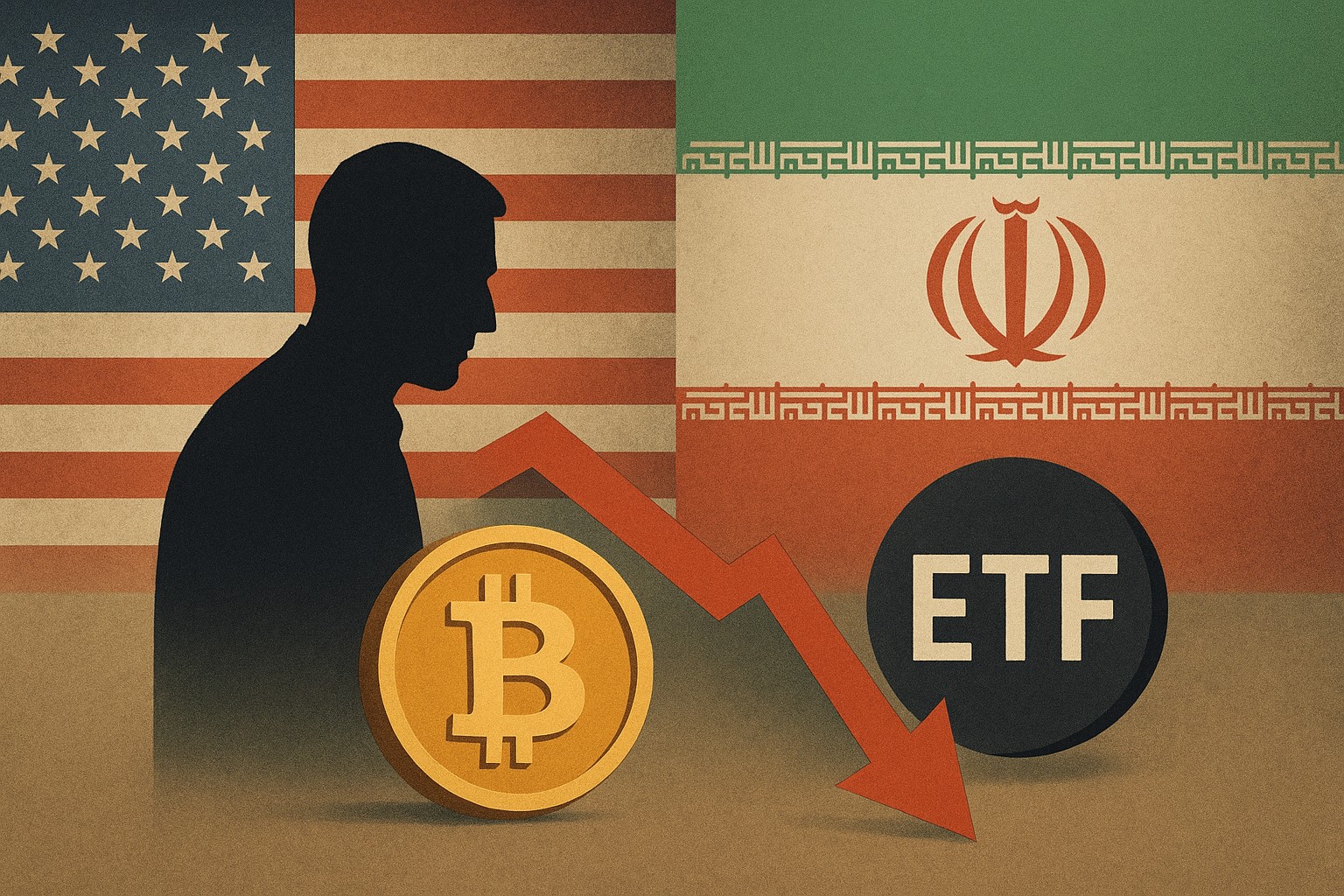
US-Iran tensions return to the spotlight as Bitcoin pulls back and ETF activity cools. When geopolitics collides with crowded crypto positioning, price action can turn messy fast—and this week’s tape is a reminder that macro still matters.
Quick Take: what’s moving Bitcoin right now
Bitcoin’s recent pullback is happening at the same time that headlines around US-Iran tensions have re-entered the mainstream news cycle, and that combination tends to compress risk appetite across markets. In crypto, “risk appetite” is often visible not only in price, but in leverage, funding rates, options skews, and—importantly in 2024–2026—spot Bitcoin ETF flows.
What stands out to me is how quickly sentiment can flip from buy-the-dip to capital-preservation mode. When investors sense geopolitical uncertainty, they often reduce exposure to the most reflexive assets first—those that can move sharply on thin weekend liquidity or momentum-driven flows. Bitcoin is liquid and global, which is a strength, but it also means it becomes a shock absorber.
This article breaks down the key transmission channels: how geopolitical shocks hit energy and risk assets, what leveraged positioning implies, why institutional retreat shows up in ETF activity, and how to think about “technical correction vs structural shift” without getting trapped by short-term noise.
Geopolitical shocks hit energy and risk assets
Geopolitical events rarely impact Bitcoin in isolation. They typically move through energy markets, rates expectations, and broad risk sentiment first—then spill into crypto via liquidity conditions and portfolio rebalancing. Oil spikes or even heightened volatility in crude can feed inflation concerns, which can keep financial conditions tighter than risk assets want.
In practice, that means a risk-off day in equities can coincide with crypto weakness even if the crypto-specific newsflow is calm. Traders who treat Bitcoin like a high-beta macro asset will de-risk when volatility rises elsewhere, and systematic strategies may cut exposure when correlations change abruptly.
My personal read: the crypto market still underestimates how “global macro” Bitcoin has become since the rise of regulated access products. When spot ETFs and institutional allocators participate, the asset increasingly reacts to the same uncertainty signals that move other risk markets—especially during headline-driven weeks.
Institutional retreat: ETF outflows accelerate as activity cools
Spot Bitcoin ETFs have become a daily scoreboard for institutional demand, but interpreting it requires nuance. Outflows don’t automatically mean long-term bearishness; they can reflect profit-taking, hedging, quarter-end risk management, or rotation into other vehicles. Still, when headlines intensify and price retreats, net redemptions can amplify the move by removing a steady source of spot demand.
Cooling ETF activity also affects market psychology. During strong inflow regimes, dips often get bought because participants expect consistent ETF absorption. When flows slow or reverse, traders become less confident that there’s a large, price-insensitive bid waiting below—so bids pull back, spreads widen, and volatility rises.
If you’re monitoring this like a pro, don’t just watch one day. Track:
– Net flows over a rolling 5–10 trading-day window
– Whether outflows coincide with rising realized volatility
– Whether price weakness is occurring alongside stronger USD or higher real yields
Those correlations often tell you whether the ETF tape is driving price—or simply reflecting the same macro impulse.
Leveraged longs face cascades: liquidation risk and positioning
One reason crypto can drop quickly during geopolitical stress is leverage. When traders are positioned heavily on the long side, even a modest decline can trigger forced selling—liquidations that become self-reinforcing. This is why you’ll sometimes see sharp downside wicks that feel disproportionate to the original headline.
Leverage doesn’t just sit on perp exchanges; it exists through options structures, basis trades, and cross-margin portfolios. When volatility jumps, margin requirements rise and risk engines tighten. That can force de-risking even among participants who weren’t “wrong” directionally—just overextended relative to the new volatility regime.
Practical risk checks I use during headline weeks
- Funding rates and open interest
- Elevated funding + rising OI can signal crowded longs
- Falling price + stubborn OI can hint at liquidation pressure still ahead
- Liquidation maps and key levels
- Identify clusters below recent swing lows
- Treat them as risk zones, not guaranteed magnets
- Options positioning
- Watch put demand, skew steepening, and rising implied vols
- A jump in short-dated IV often signals stress before spot fully reacts
If you’re a long-term holder, the takeaway isn’t to obsess over every liquidation print. It’s to recognize when the market is fragile—because in fragile markets, stop placement, position sizing, and time horizon matter more than being “right.”
On-chain data signals a double risk-off regime
On-chain metrics can help separate a healthy pullback from a more defensive shift, but only if you focus on a few high-signal indicators. A “double risk-off” regime is when both speculative demand (new buyers, short-term holders) and liquidity conditions (exchange flows, stablecoin risk appetite) soften at the same time.
Common signs include reduced spot momentum, more cautious behavior from short-term holders, and a preference for sidelining capital in stablecoins rather than rotating aggressively back into BTC. However, on-chain data is often slower than price—so the goal is not to predict the next candle, but to confirm whether the market is transitioning into a different behavioral phase.
The most useful way to apply on-chain during geopolitical uncertainty is as a filter:
– If price drops but long-term holder behavior remains steady, it may be a volatility event.
– If price drops and long-term holders begin distributing meaningfully, it can hint at a deeper shift in conviction.
In my experience, most geopolitical dips fall into the first category unless they materially alter global liquidity expectations.
Technical correction or structural shift? How to frame the pullback
The question everyone asks is whether this is just a technical correction or something more persistent. A technical correction usually features sharp moves, scary headlines, and quick mean reversion once positioning clears and volatility normalizes. A structural shift tends to show up as a sustained change in trend, repeated failure to reclaim key levels, and a persistent deterioration in flows and breadth.
From a practical standpoint, I like to use three layers of confirmation:
1. Market structure: are higher lows still intact on higher timeframes, or is the trend breaking?
2. Demand signals: do ETF flows stabilize when volatility cools, or do redemptions persist even on green days?
3. Liquidity and macro: are real yields rising, is the dollar strengthening, and is oil volatility keeping risk assets pinned?
It’s also worth remembering that Bitcoin can be both: a structural bull market can still experience violent corrections. What changes your decision-making isn’t the label—it’s your plan. If you’re trading, define invalidation levels and size for volatility. If you’re investing, define time horizon and rebalance rules so you’re not making high-stress decisions mid-headline.
Conclusion: prepare for volatility, don’t outsource your process
US-Iran tensions returning to the spotlight as Bitcoin pulls back is a reminder that crypto isn’t insulated from geopolitics—especially now that ETF access links BTC more tightly to broader portfolio behavior. Cooling ETF activity can remove a stabilizing bid, while leverage can turn a normal dip into a fast cascade.
The most actionable approach is to treat these periods as volatility regimes: watch flows, track leverage and positioning, and use on-chain and macro context to avoid overreacting to single data points. With a clear process—entries, exits, sizing, and time horizon—you don’t need perfect predictions to navigate headline-driven markets effectively.