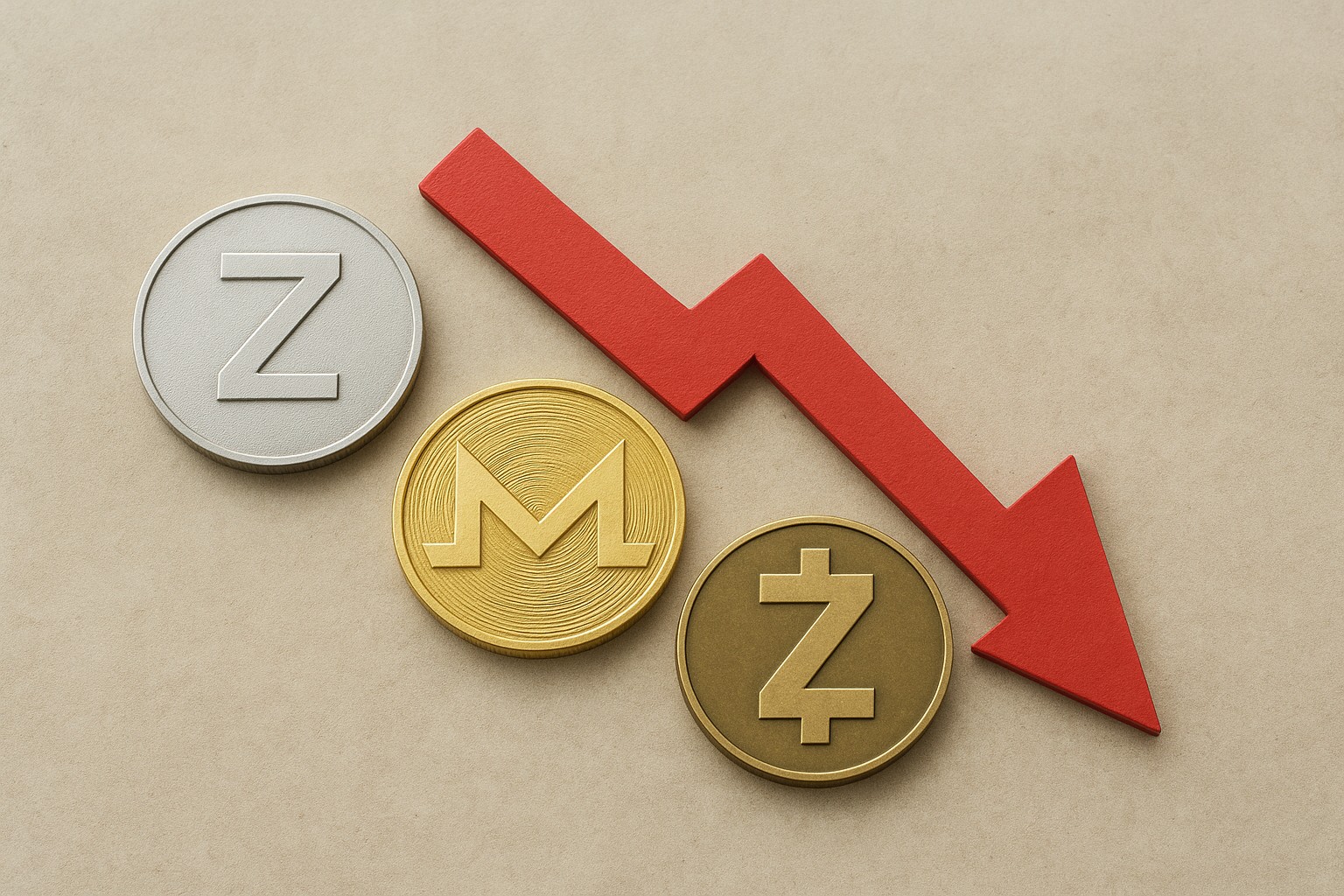
ZANO shows resilience while Monero and Zcash post 28% weekly drops. In a week defined by extreme fear and forced selling, the gap between “privacy coin” narratives and real market structure became unusually clear.
Market Conditions: Why Privacy Coins Got Hit So Hard This Week
The past week’s drawdown wasn’t only about individual projects; it was a reminder that liquidity and positioning drive crypto price action as much as fundamentals. When sentiment collapses and leverage unwinds, assets with thinner order books or concentrated holders can move faster than expected—both up and down.
Privacy coins often sit in a tricky spot during broad volatility. On one hand, they have a dedicated user base and strong ideological tailwinds. On the other, they can be more exposed to exchange availability changes, sudden risk-off behavior, and headline sensitivity. In these environments, price can disconnect from product progress for longer than most investors expect.
I’ve also noticed that during “panic weeks,” traders tend to simplify their exposure: they keep the most liquid majors, cut the rest, and rotate later. That dynamic can explain why even well-known privacy assets can drop sharply, while a smaller token with different liquidity distribution may hold steadier.
Token Context: Comparing ZANO vs Monero (XMR) vs Zcash (ZEC)
The headline comparison—ZANO staying relatively stable while Monero and Zcash fell roughly 28%+ on the week—matters because it challenges the assumption that the largest market cap automatically implies the most resilient chart. Market cap influences perception, but day-to-day resilience often comes down to who is trading, where the liquidity sits, and how reflexive the market is in the short term.
Monero (XMR) and Zcash (ZEC) remain the best-known privacy-focused assets, with long histories, established communities, and strong brand recognition. However, that “household name” status can be a double-edged sword: they are more widely held, more widely traded, and sometimes more widely used as a hedge or a short—especially during turbulent weeks.
ZANO, by contrast, has tended to trade with a different rhythm. It can behave more like a tightly held ecosystem token: less prone to cascade liquidations if leverage is lower, but also more dependent on a smaller set of venues and consistent organic demand. That doesn’t make it “better” by default—but it does help explain why performance gaps can open up quickly.
What Is Zano: A Practical Primer for Newcomers
Zano is a privacy-oriented blockchain project that has been building for years rather than chasing quick narrative cycles. The simplest way to describe it is a network designed for private value transfer, with additional tooling intended to support privacy-preserving assets beyond a single native coin.
One of the more useful ways to evaluate Zano is to look at its product surface area: not only whether transactions can be private, but whether the system can support broader real-world usage—wallet support, integrations, and mechanisms that let other assets or applications inherit privacy features. For many users, privacy is not a feature they toggle; it’s a default expectation, and Zano’s design aims to make that default practical.
Key Notes (Quick Takeaways)
- ZANO’s relative steadiness can reflect lower leverage, different holder composition, and thinner—but potentially less reactive—sell pressure
- XMR and ZEC drops can be amplified by broader market deleveraging and “risk bucket” selling
- For long-term evaluation, focus on wallets, integrations, roadmap credibility, and how privacy features work in practice
Project Developments: Roadmaps, Integrations, and Real Utility
When prices are bleeding, fundamentals can feel irrelevant—but for investors who care about durability, this is when fundamentals matter most. Zano’s ongoing development focus has centered on network resilience, privacy upgrades, and interoperability—three themes that tend to outlive short-term market panics.
Integrations are also a practical signal. If a privacy coin can be used through mainstream-friendly wallets, or if spending paths exist through payment partnerships and regional rails, it reduces the “speculation-only” profile. The more ways users can hold, move, and spend an asset, the more its demand base diversifies beyond traders.
My personal filter here is simple: I’m less impressed by vague announcements and more persuaded by shippable milestones—things a user can touch. Wallet availability, bridges that preserve confidentiality, and clear upgrade sequencing are the kinds of progress markers that can support resilience even when charts look ugly.
Market Structure: Liquidity, Leverage, and Why ZANO Can Diverge
It’s tempting to search for a single news item that explains why one token holds steady while others drop. In reality, divergences often come from microstructure: where the bids are, how deep the books are, whether perpetuals are crowded, and how quickly forced sellers hit the market.
Monero and Zcash are large enough to be actively traded across venues and to attract derivatives interest. That increases liquidity in normal times, but it can also increase reflexivity during stress—liquidations push price down, which triggers more margin calls, which triggers more selling. If ZANO has comparatively less leveraged positioning, it can “skip” part of that cascade.
There’s also the question of who holds the supply and why. A token dominated by longer-term users may show less day-to-day volatility, even if it’s smaller. That doesn’t remove risk—smaller assets can still gap hard—but it changes the short-term behavior during a fear spike.
Risk Checklist: How to Evaluate Privacy Coins During Extreme Fear
If you’re analyzing ZANO, XMR, ZEC—or any privacy coin—during a volatile week, a structured checklist beats gut feel. The goal is to separate price action (which can be noisy) from survivability (which is more durable).
Start with accessibility and custody. Can you store it safely in reputable wallets? Is liquidity spread across multiple venues or concentrated in one place? Then evaluate the chain’s development cadence and whether upgrades are realistic rather than purely aspirational.
Finally, consider regulatory and exchange-listing fragility as a real risk factor. Privacy coins have unique strengths, but they can also face unique constraints. If you plan to hold long term, treat “where can I trade this later?” as part of your thesis—not an afterthought.
Conclusion: Resilience Is a Signal, Not a Guarantee
ZANO’s ability to stay comparatively steady while Monero and Zcash posted steep weekly declines is worth paying attention to, especially for investors who track market structure as closely as technology. It suggests that positioning, liquidity shape, and holder behavior can matter as much as brand size in crisis weeks.
Still, resilience over a single week is a signal—not a verdict. If you’re considering exposure, focus on the basics: real usage paths, integration breadth, roadmap credibility, and the specific risks privacy coins carry in exchange availability and market sentiment. In the end, the best privacy-coin thesis is the one that still makes sense after the panic fades.