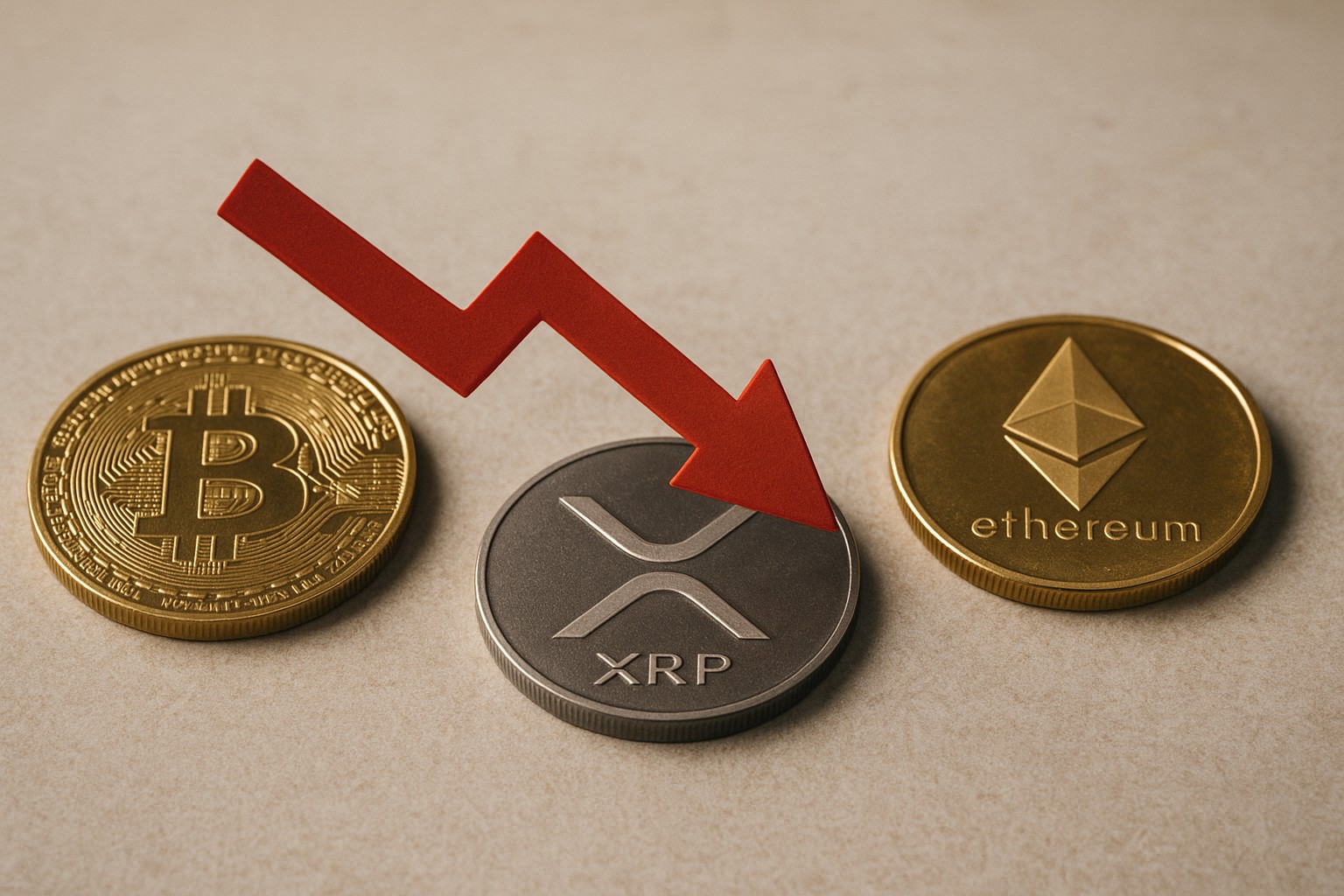
Bitcoin and Ethereum sell off puts the spotlight on XRP’s next direction, because when BTC and ETH wobble, capital quickly rotates into (or out of) large-cap alternatives. In this guide, I’ll break down what the sell-off changes for XRP, what to watch on-chain and on charts, and how to think about risk if volatility persists.
Why the Bitcoin and Ethereum sell-off matters for XRP right now
When Bitcoin and Ethereum experience sharp drawdowns, the immediate impact is psychological as much as mechanical. BTC and ETH are the market’s liquidity anchors; when they sell off, leverage gets reduced, risk budgets shrink, and traders become selective about what they hold overnight. XRP often sits in the cross-currents: it can be treated as a high-beta altcoin during fear, yet it can also attract rotation when traders search for “catch-up” moves after capitulation.
In practice, XRP’s next direction tends to depend on whether the BTC/ETH drop is a temporary deleveraging event or the start of a broader risk-off regime. If BTC stabilizes quickly, XRP can benefit from renewed speculative appetite. If BTC continues to slide or volatility remains elevated, XRP may be forced into a longer bottoming process, where price chops sideways and sentiment gets tired.
One more nuance: XRP’s narrative drivers can decouple it from the rest of the market for short bursts, but correlation usually returns during macro stress. That’s why it’s worth treating XRP not as an isolated chart, but as part of a larger flow—BTC liquidity, ETH risk appetite, and the altcoin funding environment.
Does a drop in cryptocurrency prices affect returns?
Yes—price drops affect returns in more ways than most people calculate in the moment. The obvious effect is mark-to-market losses on spot holdings. The less obvious effect is opportunity cost: when assets fall 20–40%, the hurdle rate to get back to breakeven becomes meaningfully higher, and many portfolios end up taking more risk to “make it back,” which compounds errors.
For XRP specifically, a downturn changes the behavior of different market participants. Long-term holders may become less price-sensitive and stop selling, which can help a base form. Short-term traders, meanwhile, often reduce position size and tighten time horizons. That combination can create a low-liquidity environment where price looks stable, but sudden spikes (up or down) happen faster than expected.
From a practical standpoint, “returns” should be thought of in scenarios, not single-point forecasts. In a choppy market, the same coin can produce very different outcomes depending on entry, position sizing, and whether you have a plan for adding, trimming, or staying flat. Personally, I find it helpful to define my risk first—what I’m willing to lose—before I start imagining what I might gain.
XRP’s next direction: key technical levels and market structure to watch
XRP’s near-term outlook often comes down to whether it can hold a credible base while the rest of the market digests BTC/ETH weakness. A base is not just one bounce; it’s a sequence of higher lows (or at least equal lows), improving volume on up days, and fewer sharp sell-through candles. If XRP keeps making lower lows while BTC is stabilizing, that’s usually a warning sign.
Market structure matters because XRP tends to move in phases: compression, breakout, retrace, and then either trend continuation or failure. During the compression phase, price can feel boring—this is often where traders get chopped. During the breakout phase, it can feel inevitable—this is often where traders overextend. The trick is to track the structure objectively: where did the last impulsive move start, where did it stop, and did the pullback hold above the prior base?
Practical checklist for reading XRP’s setup
- Support zones: Identify the most recent consolidation floor and the prior swing low; watch how price reacts on retests.
- Volume behavior: Look for rising volume on advances and shrinking volume on pullbacks; the opposite often signals weak demand.
- Relative strength: Compare XRP’s performance to BTC and ETH over the same window; sustained outperformance can hint at rotation.
- Funding/leverage signals: If perpetual funding stays elevated during a weak tape, downside risk can increase from forced unwinds.
- Time factor: Bases take time; multiple failed bounces can still be constructive if lows aren’t accelerating downward.
None of this guarantees direction, but it makes you less dependent on headlines. In volatile markets, the edge is often in preparation—knowing what you’ll do if support holds, and what you’ll do if it breaks.
How can one generate stable passive income during periods of market downturn and volatility?
In crypto, stable passive income is a tricky phrase because most yield ultimately comes from taking some form of risk—smart contract risk, counterparty risk, liquidity risk, or price risk. Still, there are ways to aim for steadier outcomes than pure directional bets, especially when BTC and ETH sell off and trend confidence is low.
A practical starting point is to separate “income” into two categories: yield that is directly exposed to token price, and yield that is relatively less sensitive day-to-day (though never risk-free). For example, lending or staking programs may produce token-denominated rewards that look stable in units, but fluctuate in fiat value. Meanwhile, some structured products or hedged strategies attempt to smooth returns by sacrificing upside.
Here are common approaches investors explore during downtrends, along with the trade-offs you should evaluate before committing funds:
– Staking or delegated staking (if available): simpler, but often exposed to price and lock-up constraints
– Overcollateralized lending: can be steadier, but liquidation and platform risk matter
– Options-based yield (covered calls/cash-secured puts): can monetize volatility, but caps upside or increases drawdown risk
– Market-neutral/hedged strategies: aims to reduce directionality, but depends heavily on execution and fees
– Dollar-cost averaging plus cash management: not “income,” but often improves survival and decision quality
My personal bias in downturns is to prioritize resilience: keep liquidity, avoid opaque yield promises, and assume correlations will spike when things get ugly. If you can stay solvent and calm, you’ll often find better opportunities after the market stops panicking.
Risk management for XRP holders: scenarios, position sizing, and timing
If the spotlight is on XRP’s next direction, the best response isn’t prediction—it’s scenario planning. Consider three broad cases: (1) market rebound with BTC stabilizing and ETH recovering, (2) sideways chop with repeated fake-outs, and (3) continuation lower if macro sentiment deteriorates. For each case, decide in advance what would make you add, reduce, or exit.
Position sizing is the lever most traders underuse. XRP can move fast; a position that is “fine” in a calm week can become emotionally unmanageable during a sell-off. Using smaller size and wider invalidation levels often beats larger size with tight stops that get repeatedly hit. If you’re investing rather than trading, the equivalent is pacing entries—splitting buys into tranches so you’re not forced to be perfect on timing.
Timing also includes knowing when not to act. If BTC and ETH are still dumping and liquidity is thin, XRP can get dragged lower regardless of its own story. Waiting for stabilization—higher lows, tighter spreads, calmer funding—can reduce the odds of buying into a falling market. You won’t catch the exact bottom, but you’ll often improve consistency.
Conclusion: what the sell-off signals—and how to stay prepared for XRP’s next move
Bitcoin and Ethereum’s sell off puts the spotlight on XRP’s next direction because it forces the market to choose: risk back on, or risk still off. XRP may stabilize and build a durable base, or it may remain vulnerable if broader liquidity keeps tightening. Either way, the most useful approach is to focus on structure, not noise.
Watch how XRP behaves relative to BTC/ETH, track whether support zones hold on retests, and be honest about what kind of “return” you’re pursuing—directional upside, steadier yield, or simply better entries over time. If volatility persists, disciplined position sizing and scenario planning can matter more than any single indicator.