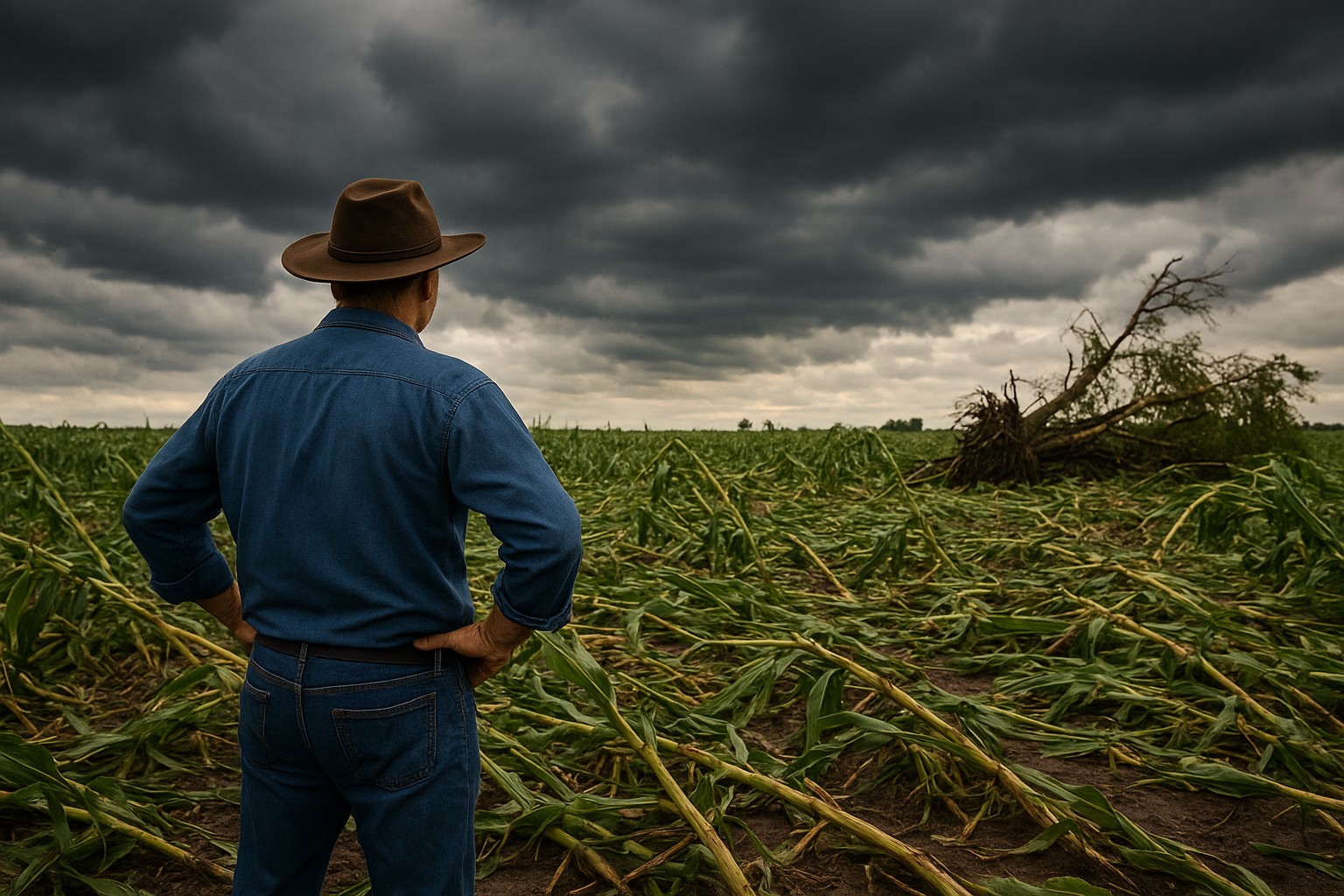
How near instant insurance payouts could help farmers bounce back after storms is not a futuristic slogan—it’s a practical way to shorten the painful gap between damage and recovery. When money arrives in days (or minutes) instead of months, farmers can replant, repair, and keep workers paid before a bad week becomes a lost season.
Why storms are becoming a bigger business risk for farms
Storms don’t just knock down crops; they interrupt the entire farm business system. A single event can damage fields, storage, fencing, irrigation, equipment, and access roads at the same time. Even when the physical harm looks localized, the cash-flow shock spreads quickly into missed planting windows, supply contract penalties, and higher borrowing costs.
What’s changed in recent years is the frequency and intensity of weather volatility. Many producers I speak with describe it as uncertainty stacked on uncertainty: input prices fluctuate, labor is tight, and then a storm arrives that forces unplanned spending immediately. Resilience isn’t only about stronger barns or better drainage—it’s also about liquidity at the right moment.
Near instant payouts matter because storms create “time-sensitive losses.” Seeds must go in the ground on schedule, mold has to be stopped early, livestock needs feed now, and repair crews book out fast after a regional disaster. If funds arrive late, farmers often pay more for the same fixes—or skip them—making next season weaker too.
Shock disasters, slow money: the hidden cost of delayed payouts
After a major storm, the real clock starts ticking long before an insurer finishes paperwork. Traditional claims processes can involve inspection queues, documentation back-and-forth, and multiple approval layers. Those steps aren’t inherently bad—they aim to prevent fraud—but they can unintentionally punish the honest majority by delaying relief when it’s most valuable.
The problem is that agriculture operates on narrow biological calendars. Waiting weeks can mean losing a replanting window; waiting months can mean losing the entire cycle and the cash needed to service debt. Many farms then rely on short-term credit, which can be expensive or simply unavailable right after a disaster when risk looks highest.
Delayed payouts also have community-level consequences. When dozens of farms in a region can’t pay suppliers or contractors, local businesses suffer too—mechanics, agronomists, feed stores, transport firms. Faster payments can stabilize the rural economy, not just individual balance sheets.
What “near instant insurance payouts” really look like in practice
Near instant payouts don’t necessarily mean skipping verification; they mean designing products so that verification can happen quickly and consistently. In many cases, this points toward parametric insurance—coverage that pays when a measurable trigger occurs (for example, rainfall above a threshold, wind speed, hail intensity, or river height), rather than paying only after field-by-field loss adjustment.
This approach can be paired with digital payment rails so farmers receive funds immediately once the trigger is confirmed. Depending on the market, that could be a direct bank transfer, a prepaid card, mobile money, or a regulated digital wallet. The key is to remove avoidable friction between the event and the payment.
It’s also important to set expectations correctly: parametric products might not match every individual loss perfectly. Some farmers will have less damage than the trigger implies; some will have more. That’s why good design matters—choosing triggers that correlate strongly with real losses and layering coverage so it complements, rather than replaces, traditional indemnity insurance.
Smart contracts can make insurance payouts automatic (and less stressful)
Automation is where the idea becomes transformational. When policy rules are encoded so that payout conditions are executed automatically, farmers don’t have to wonder whether a claim is stuck in a queue. Smart contracts can be used to release payments when trusted data sources confirm that the storm or rainfall condition occurred.
The practical advantage isn’t tech for tech’s sake; it’s operational clarity. Automated payout logic can reduce administrative overhead, shorten payment timelines, and standardize decisions. This can be particularly helpful for smaller farms that don’t have staff to chase paperwork or compile extensive proof under pressure.
How automated payouts can work end-to-end
- Policy setup: The farmer selects coverage, location, and trigger thresholds that match their crop cycle and risk profile.
- Data verification: Independent sources (weather stations, satellite data, radar, hydrology gauges) validate whether the trigger happened.
- Automatic execution: Once verified, the payout is calculated using pre-agreed rules and released immediately.
- Delivery to the farmer: Funds arrive via the fastest available rail (bank, mobile wallet, or other regulated payment method).
- Audit trail: The event, trigger, and payout logic are recorded for later review and dispute resolution.
From a farmer’s perspective, the emotional difference is real. Instead of uncertainty—Will it be approved? When will it arrive?—there’s a predictable process. In a crisis week, predictability is a form of resilience.
Transparency builds trust between farmers, insurers, and governments
Trust is one of the most under-discussed inputs in agricultural risk management. When farmers believe claims will be delayed, disputed, or inconsistently handled, they may underinsure or avoid coverage altogether—especially if past experiences have been frustrating. Transparent systems can rebuild that confidence by making rules, triggers, and timelines clearer upfront.
Transparency also matters for public-private programs and disaster relief partnerships. If governments subsidize premiums or provide backstops, they need accountability: how payouts were triggered, who received funds, and whether the program is meeting its goals. Clear reporting reduces political friction and improves program durability across election cycles.
In my view, this is where data discipline becomes just as important as payment speed. Faster payouts without transparent logic can look arbitrary, and that breeds skepticism. Faster payouts with explainable triggers and consistent records can improve participation, reduce disputes, and ultimately lower distribution costs.
Designing parametric insurance that actually helps farmers recover
A parametric policy is only as good as its trigger design and its fit with local realities. For storms, triggers might include wind gust thresholds, hail probability indices, rainfall intensity, or flood depth. But farms can vary dramatically even within a few miles—soil type, drainage, crop variety, planting date, and field orientation all change how damage shows up.
The best designs typically start by asking a recovery question rather than a product question: “What cash needs to arrive quickly to prevent a second wave of losses?” That might mean a rapid first payment sized to cover immediate actions—replanting, drying grain, replacing fencing—followed by additional coverage layers if the season’s yield collapses later.
It also helps to plan payouts around farm decision points. A payout that arrives in 48 hours can be used to secure scarce contractors, rent equipment, or purchase inputs before prices spike. A payout that arrives in 90 days may still help with debt servicing, but it won’t save a planting window.
A practical checklist for farmers considering fast-payout coverage
If you’re evaluating near instant payout options, treat it like any other major farm decision: test the assumptions, run scenarios, and check the fine print. Speed is valuable, but only when the product matches your risk and your operations.
First, confirm what “instant” truly means. Is it instant after the trigger is recorded, or instant after manual review? What are the data sources and how often are they updated? Does a weekend or holiday affect payouts? Farmers don’t need flashy promises—they need dependable timelines.
Second, examine basis risk—the chance the payout doesn’t match your specific loss. Ask for historical examples: What would this policy have paid in the last five storm seasons on your farm’s coordinates? A reputable provider should be able to show back-testing and explain how triggers were chosen.
Third, look at how you’ll receive the money and how easily you can use it. If the payout lands in an account that’s hard to access locally, the benefit is reduced. The best payout is the one you can deploy immediately: paying labor, buying inputs, renting pumps, or repairing storage before spoilage spreads.
Conclusion: Speed turns insurance from paperwork into recovery capital
Near instant insurance payouts can change storm recovery from a slow administrative process into usable working capital—right when farms need it most. By reducing the time between damage and liquidity, farmers can protect yield potential, stabilize labor and supplier relationships, and avoid costly emergency borrowing.
The path forward isn’t only technological; it’s also about good product design and trust. When parametric insurance is thoughtfully built, and when automation and transparency are used to make decisions consistent, faster payouts can become a practical tool that helps farmers bounce back after storms—season after season.