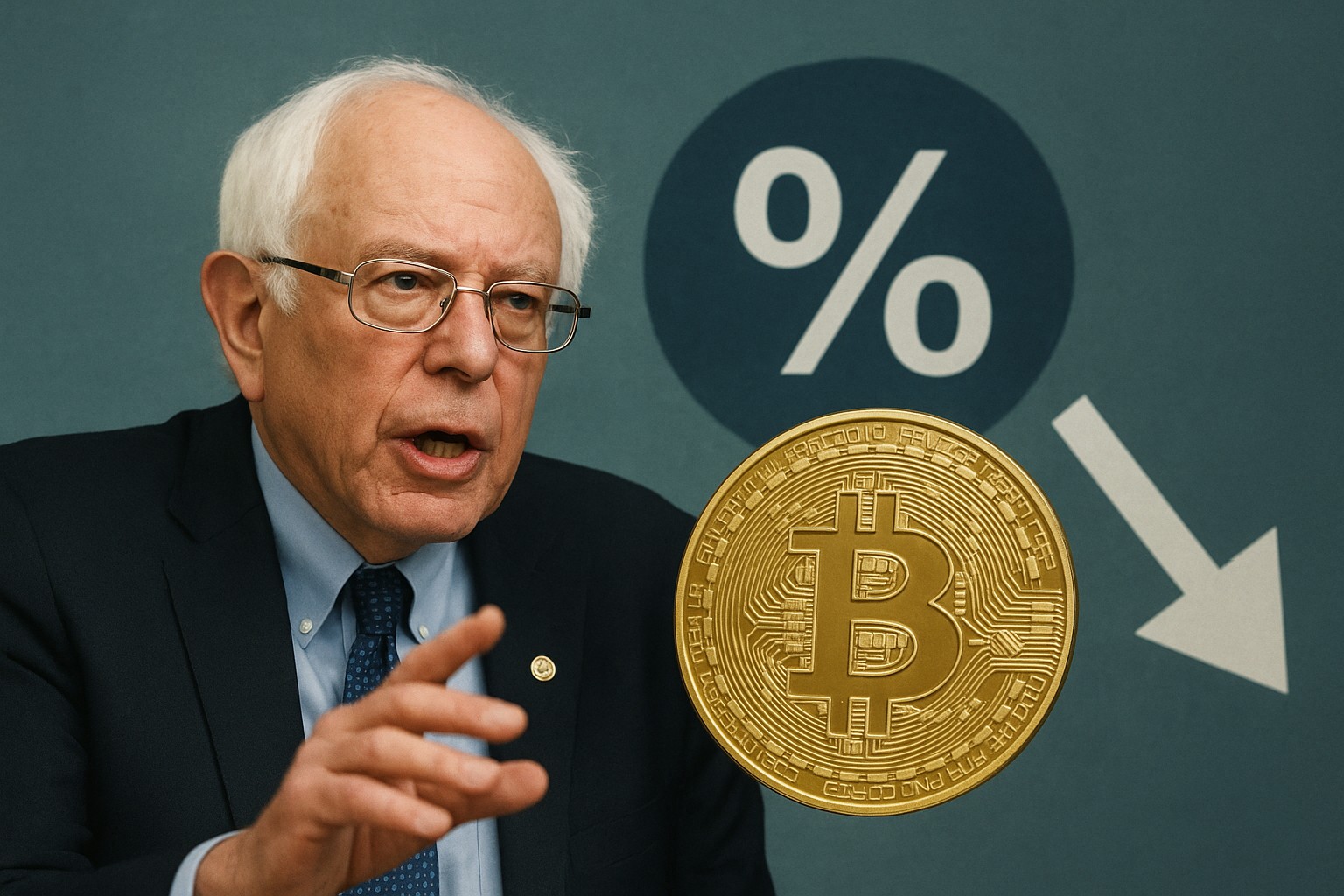
Sanders advocates interest rate reductions as crypto gauges shifting Fed signals, and that tension is becoming a real-time catalyst for risk assets. In the background, traders are balancing political calls for easier policy against a central bank that still sounds data-dependent and cautious.
Why Sanders’ rate-cut advocacy matters now
When a prominent political figure like Sanders pushes for interest rate reductions, it doesn’t directly set monetary policy—but it can reshape the narrative that markets trade. Expectations are often the first domino: if investors believe pressure for easing is building, they start re-pricing future growth, liquidity, and risk appetite long before the Federal Reserve changes a single rate.
That matters for crypto because digital assets are uniquely sensitive to liquidity conditions and discount rates. Bitcoin and major altcoins tend to perform best when financial conditions loosen, real yields fall, and investors feel confident taking duration and risk. Even if the Fed remains patient, a louder political drumbeat can still move the probability-weighted outlook that traders use.
At the same time, it’s worth acknowledging a practical reality: political pressure is rarely a clean, one-directional bullish signal. Markets must judge whether the advocacy reflects genuine economic softening (which can be bearish for earnings and sentiment) or merely a policy preference that the Fed may ignore.
Political pressure builds for easier Fed policy
“Political pressure builds for easier Fed policy” is not just a headline trope—it’s a recurring pattern whenever growth feels uneven or the labor market shows pockets of strain. Politicians focus on household costs, borrowing rates, and employment optics, while the Fed focuses on inflation trajectories, expectations, and long-run credibility.
In periods where inflation has proven sticky, Fed officials typically signal that they would rather risk keeping policy tight than re-ignite price pressures. That gap in priorities is what creates the perception of a policy rift: elected officials argue for relief sooner, and the central bank argues that premature easing could be costly.
From an investor’s perspective, the key is to treat political commentary as a sentiment input, not a policy trigger. It can influence market psychology, media framing, and even internal Fed debates at the margin, but it does not override inflation prints, wage growth, and financial conditions. If you’re trading crypto, it’s safer to interpret this as a volatility amplifier rather than a guaranteed pivot.
The Fed’s “higher for longer” regime and shifting signals
Crypto traders often summarize the current backdrop as a “higher for longer” regime—meaning rates stay elevated until inflation convincingly cools or economic weakness becomes undeniable. But what’s tricky is that Fed signals can shift without an actual rate move: changes in dot plots, press conferences, and even the tone of speeches can alter market pricing.
That’s why crypto “gauges shifting Fed signals” so intensely. Crypto markets trade 24/7, react quickly to macro headlines, and tend to express liquidity expectations more dramatically than many traditional assets. A subtle change—like emphasizing patience, or highlighting upside inflation risks—can tighten financial conditions immediately through stronger dollars, higher real yields, and weaker risk sentiment.
My personal take: many traders overweight single headlines and underweight the Fed’s reaction function. Instead of asking, Will they cut soon? the more useful question is, What data would force them to cut, and how close are we? The distance between today’s data and that threshold is what should anchor positioning.
What a cut — or delay — means for crypto markets
“What a cut — or delay — means for crypto” depends on why it happens. A rate cut driven by falling inflation and stable growth tends to be constructive for risk assets, including crypto. A cut driven by a sharp downturn can be messy: liquidity improves, but fear rises, leverage unwinds, and correlations can spike.
In the near term, delays in easing usually translate into a stronger dollar and firmer yields—two conditions that often cap speculative upside. That doesn’t mean crypto must fall; it means rallies may become more selective, favoring higher-quality narratives (spot ETF flows, protocol revenue, real adoption) rather than broad beta.
In the medium term, even the credible possibility of easing can lift sentiment. Crypto markets are forward-looking, and traders frequently buy the expectation of a pivot before it arrives. The practical challenge is timing: if the Fed remains cautious for longer than the market expects, over-levered positions can unwind quickly and painfully.
How crypto investors can track Fed signals (without getting whipsawed)
The easiest way to get chopped up is to react to every speech or political statement. A more durable approach is to build a simple, repeatable dashboard that translates macro inputs into a risk posture—then only change that posture when the dashboard changes meaningfully.
A simple checklist for macro-to-crypto decision-making
Use parallel indicators so you’re not relying on a single point of failure:
- Inflation trend: Core inflation momentum, not just one month’s headline number
- Labor cooling: Unemployment rate, job openings, wage growth, hours worked
- Financial conditions: Dollar strength, real yields, credit spreads, liquidity measures
- Fed communication: Dot plot direction, press conference tone, key speech themes
- Market pricing: Rate-cut probabilities implied by futures, yield-curve shifts
- Crypto internals: ETF flows (if applicable), stablecoin supply, funding rates, on-chain activity
Put differently: political advocacy like Sanders’ can be the spark, but the fuel is still inflation and labor data. If your checklist shows conditions tightening, it’s rational to be more defensive even if the headlines sound dovish.
One practical tip I’ve learned the hard way: decide in advance which data releases matter most to your time horizon. If you’re a swing trader, you may care about the next CPI and jobs report. If you’re a long-term holder, you may care more about the 6–12 month trend in real yields and liquidity, plus crypto-specific adoption signals.
Scenarios to watch: from soft landing to renewed inflation
To make this actionable, it helps to map a few scenarios and attach “if-then” expectations rather than a single forecast. Crypto tends to punish certainty when macro is ambiguous, so scenario planning can keep you flexible without being reactive.
A soft-landing scenario—where inflation gradually eases and growth stays positive—often supports a constructive crypto trend. In that environment, even slow or modest rate cuts can improve liquidity expectations and boost risk appetite, particularly for bitcoin and large-cap protocols with strong market structure.
A renewed inflation scenario is different: if energy or supply shocks push prices up again, the Fed may emphasize restraint. That can strengthen the dollar and raise real rates, often pressuring crypto valuations. Meanwhile, a recessionary scenario can produce a short-term drawdown from deleveraging, followed by a more favorable setup if easing becomes aggressive and liquidity returns.
The point isn’t to predict perfectly. The point is to recognize which regime you’re in early—and adjust position sizing, leverage, and time horizon accordingly.
Conclusion: Reading the politics, trading the data
Sanders advocates interest rate reductions as crypto gauges shifting Fed signals, but the market ultimately trades the Fed’s reaction function—especially inflation momentum, labor cooling, and financial conditions. Political pressure can influence sentiment and framing, yet it rarely replaces the data that drives policy decisions.
For crypto investors, the edge comes from filtering noise, tracking a small set of repeatable indicators, and preparing for multiple macro paths. If rate cuts arrive under the “right” conditions, crypto may benefit from improved liquidity and risk appetite; if cuts are delayed, resilience will likely depend more on fundamentals, positioning, and disciplined risk management.