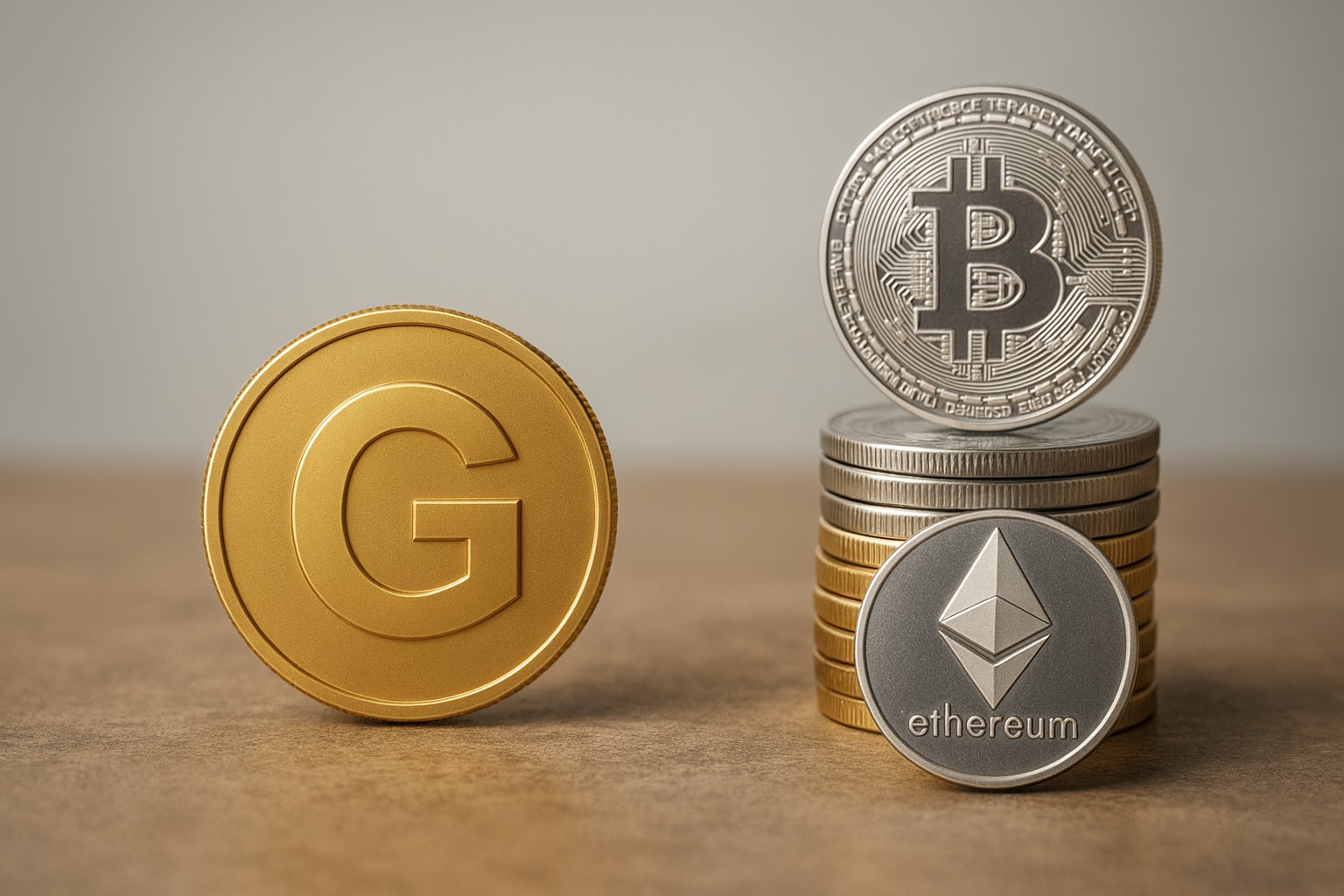
G Coin vs other cryptocurrencies is ultimately a question of what the token is designed to do, not just how it trades. In this guide, I’ll break down where G Coin tries to stand apart, what to scrutinize before you buy, and how it compares with the coins most people already understand.
Introduction: Why “Different” Matters in Crypto
Most crypto comparisons stop at price charts, market cap, and social buzz. That’s useful, but it often misses the real driver of long-term value: whether a token solves a clear problem better than alternatives. When people search G Coin vs other cryptocurrencies what makes it different, they’re usually trying to separate narrative from substance.
G Coin is often discussed in the context of on-chain entertainment use cases (think gaming-like experiences, trading-style interactions, and other real-time digital activities). That positioning can be compelling, but it also demands a more practical evaluation framework than you’d use for a simple payment coin or a pure governance token. I’ll keep this article grounded: what the project claims, what to verify, and how to compare it with better-known crypto categories.
Market: How G Coin Competes for Attention and Liquidity
In the market sense, G Coin is not only competing with Bitcoin or Ethereum; it’s competing with every token trying to be the “default currency” inside an ecosystem. That means liquidity, exchange coverage, and a credible route to sustained demand matter as much as the tech.
One key difference versus many legacy cryptocurrencies is that G Coin’s narrative tends to center on being an economic rail within a multi-app environment rather than being a general-purpose store of value. In practice, that shifts the market question from “Will this be digital gold?” to “Will enough users repeatedly need this token to do things?”
If you’re comparing G Coin to other cryptocurrencies, look at market signals that reflect utility demand, not just speculation. Examples include whether activity is concentrated in one platform, whether volume appears cyclical around campaigns, and whether liquidity is deep enough to handle drawdowns without severe slippage. My personal rule: if liquidity is thin, even a great idea can become untradeable at the worst moment.
Technology: What G Coin’s Design Optimizes For
When we talk about technology, the most important distinction is what the system is optimized for: decentralization at all costs, maximum throughput, minimal fees, or seamless user experience. Many “everyday” tokens are built on the premise that users will tolerate wallets, gas fees, and transaction friction. Entertainment-style ecosystems often bet the opposite: remove friction first, then onboard the user.
G Coin is commonly associated with experiences where speed and simplicity are central—especially where frequent actions (trades, in-app interactions, game-like events) would feel broken if users had to approve dozens of transactions and pay fees each time. This is a different design target than, say, Bitcoin (security-first) or Ethereum mainnet (decentralization and composability with higher cost).
That said, “gasless” or low-friction experiences usually require architectural trade-offs. You should verify where complexity is moved: to relayers, platform operators, permissioned components, or specialized infrastructure. The more the system relies on a small set of operators to keep UX smooth, the more your risk profile shifts from purely protocol risk to platform and operational risk.
Tokenomics: Supply, Incentives, and Where Value Might Accrue
Tokenomics is where many projects either earn trust or lose it. If G Coin is meant to function as the spending and settlement unit across multiple experiences, then the token’s value depends on (1) sustainable usage and (2) a credible reason the token is required rather than optional.
A practical tokenomics checklist is: How is supply distributed? What portion is circulating today versus locked or controlled? Are incentives encouraging real activity or short-term farming? If rewards are paying users to “be active,” you want to see a plan for transitioning to organic demand—otherwise activity can fall off sharply when incentives shrink.
Pros & Cons (Tokenomics & Incentives View)
- Pros
- Can create recurring demand if the token is genuinely required for core actions (fees, access, settlement, rewards).
- Ecosystem tokens can benefit from network effects when multiple apps share the same unit of account.
-
If designed well, incentives can bootstrap early liquidity and user growth.
-
Cons
- If circulating supply, unlock schedules, or treasury controls are unclear, pricing can be distorted and trust can erode.
- Utility can be bypassed if users can transact without holding the token (e.g., abstracted payments), weakening long-term demand.
- High emissions can mask weak product-market fit; volume may not equal sustainable adoption.
Tokenomics comparisons also depend on what you’re comparing against. Bitcoin’s value proposition isn’t driven by emissions incentives for app usage. Many DeFi governance tokens accrue value via fees or voting power. An entertainment-oriented token may rely more on throughput of micro-interactions—which can be strong, but only if retention is real.
Team & Investors: Credibility Signals You Can Actually Verify
The team & investors section is often treated like fluff, but it’s one of the most actionable areas for risk assessment—especially for ecosystem-style tokens. If a project’s value depends on ongoing platform development, partnerships, and compliance choices, execution capability matters.
Instead of focusing only on logos and headlines, verify operational credibility: Are the developers public and consistent across time? Is there a clear corporate structure? Are audits and security reviews available for the contracts that actually matter? Is documentation specific (numbers, addresses, timelines) rather than purely marketing language?
I’ll add a personal note here: the crypto space rewards confident storytelling, so you have to intentionally look for boring proof. Boring proof includes reproducible on-chain data, clear token contract references, investor disclosures where applicable, and security write-ups that describe scope and limitations. If you can’t find these, treat it as a risk premium you’re paying.
Learn: G Coin vs Other Cryptocurrencies by Category (A Practical Comparison)
The fastest way to understand what makes G Coin different is to compare it against crypto categories people already know. This learn-style breakdown is more useful than a coin-to-coin flame war because it maps differences to real expectations.
If G Coin is positioned as a utility token for an on-chain entertainment stack, its strongest comparison set is not just BTC/ETH; it’s also GameFi tokens, exchange-like utility tokens, and ecosystem coins that aim to be used repeatedly. The “different” part is typically about frequency of use and UX expectations rather than pure decentralization.
Here’s how to frame the comparison in everyday terms:
– Vs. Bitcoin (store-of-value focus): Bitcoin prioritizes censorship resistance and monetary hardness. G Coin’s value story is more usage-driven—if activity fades, demand can fade faster.
– Vs. Ethereum (programmable settlement): Ethereum is a base layer with broad composability; G Coin is more like a “native currency” thesis for a specific environment or suite of apps.
– Vs. memecoins (attention-first): Memecoins can pump on culture alone. A utility coin needs retention, economics, and infrastructure to hold value over time.
– Vs. GameFi tokens (play-to-earn history): If G Coin aims beyond a single game into a broader entertainment economy, it may be less dependent on one title—but only if multiple experiences truly drive token demand.
To make this real: when you evaluate G Coin, ask what users do weekly that requires the token. Not hypothetically—today. Recurring behavior is the cleanest differentiator in a market full of one-time hype cycles.
Reviews: Due Diligence Steps Before You Buy or Use G Coin
Most reviews online tell you what the project claims. A useful review tells you what to check and how to check it. If you’re deciding whether G Coin is meaningfully different from other cryptocurrencies, treat it like a product plus a financial asset.
Start with these practical steps:
1. Confirm the token contracts and chain details via official channels and cross-check against explorers.
2. Check circulating supply logic: what’s liquid today, what’s locked, and what’s scheduled to unlock.
3. Look for security coverage: audits, bug bounties, and whether the audit scope matches the current deployed contracts.
4. Inspect real usage: wallet activity trends, transaction patterns, and whether activity clusters around promotions.
5. Assess dependency risk: how much relies on a single platform operator, relayer system, or centralized component.
Also, compare fee and friction. If the experience is designed to feel gasless, ask who pays the cost and under what conditions it changes. In my experience, user-friendly crypto products win adoption—until hidden costs surface. Clarity upfront is a major trust advantage.
Conclusion: What Makes G Coin Different—and How to Compare It Fairly
G Coin vs other cryptocurrencies isn’t a simple better-or-worse debate; it’s a difference in purpose. G Coin is generally discussed as a utility-focused token aiming to power frequent, real-time digital experiences, where low friction and repeat usage matter more than being a universal store of value.
To judge what makes it different, focus on verifiable utility demand, transparent tokenomics, credible execution, and security posture. If those are strong, G Coin’s ecosystem-first approach can be a meaningful differentiator. If they’re weak or hard to verify, then the “difference” is mostly branding—and the token will likely trade like many other speculative assets during both hype and downturns.