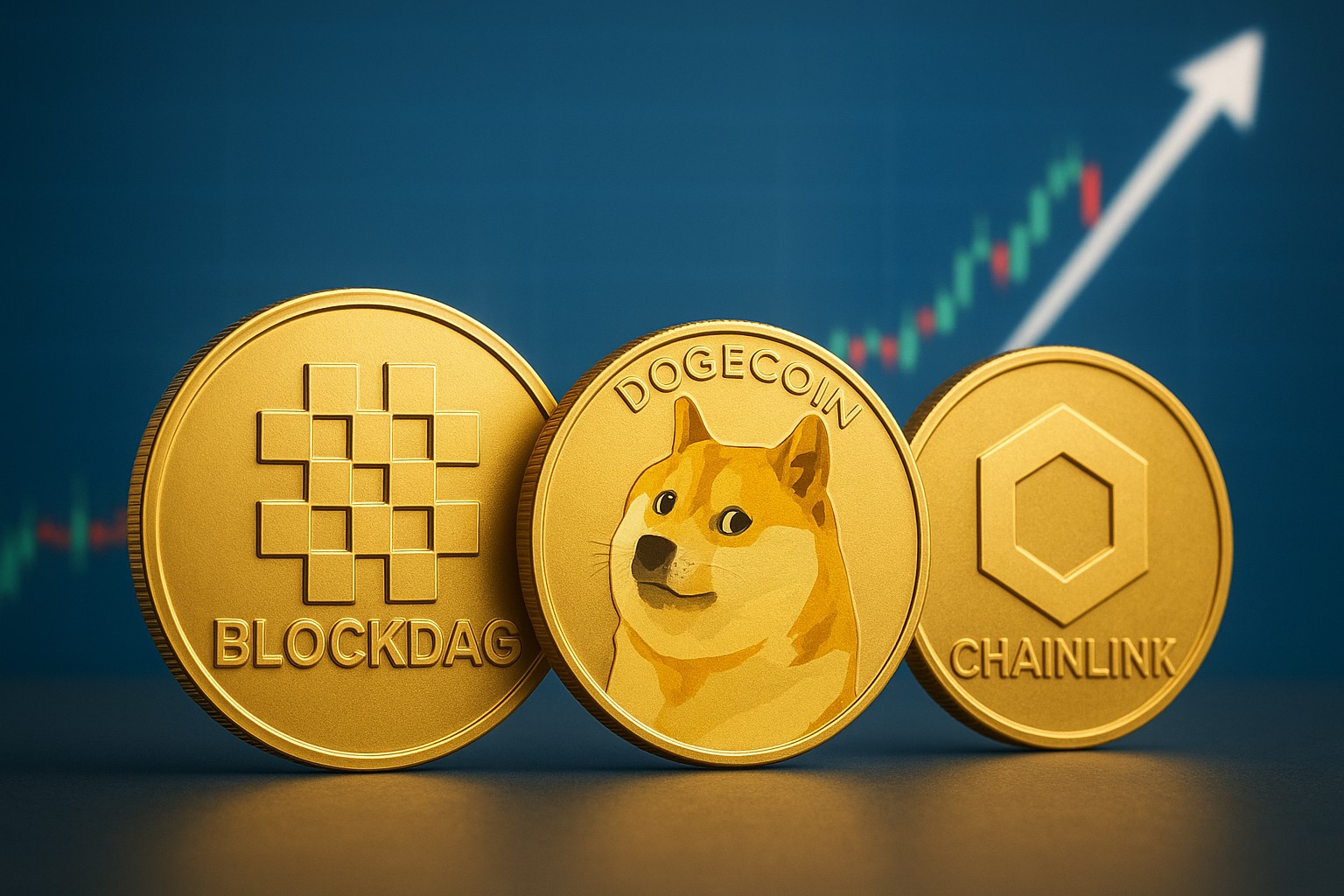
BlockDAG targets the $1 mark in April as Dogecoin and Chainlink show strong upside signals. Momentum is returning across large caps and early-stage plays at the same time, creating a market setup where disciplined planning matters as much as excitement.
Market backdrop: why upside signals are showing up together
Crypto markets often move in clusters: when risk appetite rises, liquid names like Dogecoin and Chainlink can catch bids quickly, while speculative capital rotates into newer narratives such as DAG-based architectures. That combination is what makes April feel notable—multiple segments are flashing improvement in liquidity, sentiment, and trend structure rather than relying on a single catalyst.
Still, “upside signals” should be treated as probabilities, not promises. In practice, the most useful approach is to watch whether buyers consistently defend key support zones, whether exchange balances are falling (often implying reduced near-term sell pressure), and whether derivatives stay orderly (funding, open interest, and liquidation behavior).
From a personal standpoint, I like when the market gives both technical and behavioral confirmation: a higher-low on price plus signs of accumulation. When those align, you can build a plan with defined invalidation instead of chasing headlines.
Dogecoin current price: Spot buyers lead the charge
“Dogecoin current price” is more than a number—it’s a read on crowd risk appetite. When DOGE holds a widely watched psychological level and rebounds on strong spot volume, it often signals that participants are willing to buy and hold rather than simply scalp short-term moves. That’s usually healthier than a pure futures-driven spike.
If spot buyers truly lead the charge, you’ll commonly see (1) price stabilizing after pullbacks, (2) net outflows from exchanges over short windows, and (3) fewer sharp liquidation cascades. Even without exact figures, you can track these behaviors using public dashboards for exchange reserves and basic volume/price analysis on your preferred charting tool.
Actionably, consider mapping two levels: a “bullish defense” area (where buyers repeatedly step in) and a “failure” area (where a close below changes the structure). For DOGE-style momentum trades, many traders also watch a nearby breakout trigger and size positions so a single false breakout doesn’t ruin the month.
Chainlink Price: Strategic accumulation signals a bright breakout
Chainlink tends to trade like a fundamentals-driven alt: it can move slowly while positioning builds, then reprice quickly when the market recognizes the shift. That’s why “Chainlink Price” conversations often focus on accumulation signals—especially exchange withdrawals, long/short positioning, and whether price respects a rising channel or reclaims a moving-average band.
Strategic accumulation usually looks boring on the surface. Price may grind sideways, dips get bought faster, and volatility compresses—until it doesn’t. If LINK is showing higher lows while supply on exchanges declines, that’s a classic setup where a breakout becomes more likely once a clear resistance zone is reclaimed.
Practical breakout checklist for LINK (and how to avoid common traps)
- Structure first: identify the last major lower high; a break above it matters more than a random intraday wick.
- Volume confirmation: look for rising volume on up days and lighter volume on pullbacks.
- Derivatives sanity: avoid entries when funding spikes aggressively; that’s when squeezes can reverse quickly.
- Plan the retest: many clean breakouts revisit the breakout level—decide in advance whether you’ll add, hold, or exit on the retest.
I’ll add a small, experience-based note: the best LINK moves I’ve seen often come when sentiment is lukewarm, not euphoric. If everyone is already calling for a moonshot, your risk/reward can degrade fast.
BlockDAG: The final countdown for the $0.000022 opportunity
Interest in BlockDAG-style projects often rises when investors want something with “early-entry” upside that majors can’t realistically deliver in the same timeframe. The narrative here is simple: if market attention, listings, or adoption milestones accelerate, early pricing can re-rate quickly—sometimes violently. That’s also why these setups demand stricter risk controls than large-cap trades.
When you see messaging around a fixed entry window (for example, a specific presale price such as $0.000022), treat it like a deadline-driven market. Deadlines can pull demand forward, but they can also amplify volatility if expectations get ahead of deliverables. The practical question isn’t only whether the next price step is higher—it’s whether liquidity, vesting, and distribution mechanics are clearly understood.
If BlockDAG targets the $1 mark in April, think of that as an aspirational milestone that depends on multiple levers: circulating supply realities, exchange access, market-wide conditions, and sustained demand beyond a launch phase. A useful way to stay grounded is to model scenarios (optimistic/base/conservative) and decide what evidence you’d need to shift from one scenario to another.
What to watch next: key metrics, risk management, and “top crypto gainers” behavior
Retail often searches for “top crypto gainers” and then buys what already pumped. A more repeatable approach is to track leading indicators that frequently appear before large moves: tightening ranges near support, rising spot volume, decreasing exchange balances, and clean breaks of structure with follow-through.
Risk management is where most upside theses either survive or collapse. For DOGE and LINK, the market is deep enough that you can typically use clear invalidation levels and avoid catastrophic slippage. For early-stage plays like BlockDAG, you should assume thinner liquidity and bigger gaps—so position sizing and pre-set exit rules matter even more.
A framework that stays practical:
– Define entry criteria (what must be true on the chart/on-chain before you act).
– Define invalidation (one level or condition that tells you you’re wrong).
– Define profit-taking logic (scale out at milestones rather than trying to nail the top).
– Define time risk (if price goes nowhere for X days, do you still want the trade?).
In my view, the best “upside signal” is not a single indicator—it’s confluence plus a plan. If you can’t explain your thesis in three sentences and your exit in one sentence, it’s probably not ready.
Conclusion: balancing April hype with a disciplined plan
BlockDAG targets the $1 mark in April as Dogecoin and Chainlink show strong upside signals, but the opportunity is only as good as the structure supporting it. DOGE strength tends to look healthiest when spot demand drives the move, while LINK often rewards patience when accumulation precedes a breakout.
If you’re participating, focus less on predictions and more on process: identify key levels, confirm with volume and positioning, and size trades so volatility can’t force emotional decisions. That approach won’t make every trade a winner, but it dramatically improves your odds of staying in the game long enough to catch the big moves.