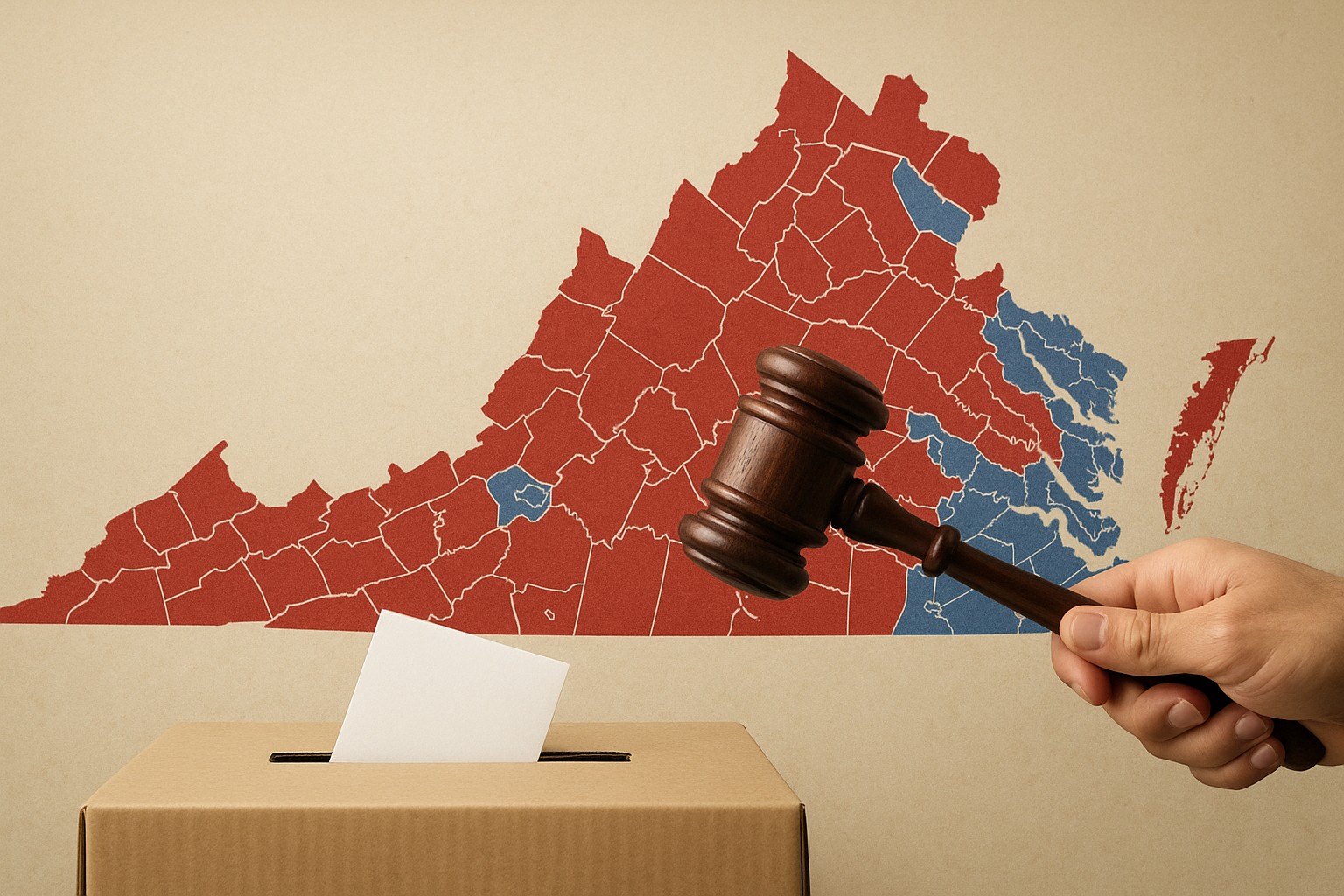
Virginia court nullifies redistricting ballot results after a razor-thin ruling that reshapes the political playing field. The decision doesn’t just rewind a referendum—it revives old district lines, accelerates legal timelines, and injects uncertainty into campaign strategy as key elections approach.
Background: How the referendum reached the ballot
Virginia has wrestled with redistricting for years, cycling between promises of fairer maps and accusations of partisan advantage. The most recent ballot measure was pitched as a structural fix—one that supporters argued would modernize mapmaking, reduce gerrymandering incentives, and better reflect statewide voting patterns. In that sense, the vote became a proxy fight about trust: trust in the legislature, trust in courts, and trust in the rules that govern elections.
What made this referendum unusually high-stakes was timing. It wasn’t a distant, academic amendment scheduled comfortably between election cycles; it landed in the middle of an active political calendar, with campaigns already budgeting and messaging based on potential new lines. When election administration and constitutional procedure collide, courts tend to focus less on the politics and more on whether the state followed its own playbook.
From a practical standpoint, that’s why the case mattered even before the ruling. If the process used to place a measure on the ballot is flawed, courts often treat the flaw as fatal—because letting results stand can incentivize “move fast and fix later” behavior in future constitutional changes. That tension sits at the heart of why this referendum was vulnerable.
The state Supreme Court ruling and the procedural fault line
The Virginia Supreme Court ultimately concluded that the ballot results could not stand, effectively wiping out the referendum outcome. While people understandably focus on the vote totals and what voters intended, the court’s lens was narrower: whether the amendment was advanced in the constitutionally required sequence and timing. In constitutional law, procedural requirements aren’t mere paperwork; they are the guardrails that legitimize the entire act of amending a governing document.
The key issue centered on timing relative to election activity. The court found that actions taken to advance the amendment occurred after early voting had already begun for a separate election, creating what the majority viewed as an incurable procedural defect. In plain English: once the state entered a sensitive phase of an election cycle, the legislature’s amendment step came too late to satisfy the process laid out for constitutional changes.
This is also why the ruling hit so hard. It wasn’t a “do-over” ordered because of confusing ballot language or a minor administrative mistake; it was a declaration that the process itself was constitutionally mis-sequenced. That kind of conclusion typically leads to the harshest remedy—nullification—because the court is saying the state never validly teed up the question in the first place.
What the ruling means for the midterms
The immediate impact is straightforward: absent a valid, newly approved redistricting framework, Virginia is likely to operate under the existing map in the near term. That reversion can alter expectations about competitiveness in multiple districts, shifting where national money flows, where parties recruit candidates, and which issues campaigns prioritize. Even if a future map emerges, uncertainty itself is a strategic disadvantage—especially for down-ballot races that rely on early organizing.
Nationally, redistricting is not a Virginia-only story. Both parties track congressional math obsessively, and small changes in a handful of seats can decide control of the U.S. House. A single state’s map can influence committee chairs, legislative calendars, and the viability of policy packages—from taxes to health care to emerging areas like technology regulation. So the court’s decision reverberates beyond Richmond.
My own read is that the ruling will also deepen voter cynicism unless leaders explain the distinction between “courts ignoring voters” and “courts enforcing process.” The average person doesn’t separate those easily. If officials want public trust, they’ll need to communicate clearly: What rule was violated? Why does it matter? And what is the clean path to do it again—without turning every election into procedural trench warfare.
Legal and political reactions: appeals, emergency stays, and messaging wars
The moment a high court nullifies a statewide vote, the next step is almost always a fast-moving appeal effort. Supporters of the referendum have signaled an intent to seek higher review and to ask for interim relief that would pause the consequences while litigation continues. The practical purpose of these requests is to prevent election administrators and campaigns from having to plan under one map today, only to be forced under another map tomorrow.
The politics around this kind of appeal are predictable but still consequential. One side frames the decision as judicial overreach that disregards voters; the other frames it as enforcing constitutional discipline and stopping a rushed or improper process. Those messages can become fundraising engines, and they can harden partisan identity in a way that makes later compromise harder—even if a technical fix is possible.
At ground level, local election officials are left managing the real-world complexity: candidate filing guidance, voter information, precinct planning, and the calendar. When a legal fight runs close to an election window, even a correct legal outcome can create operational strain. That’s why courts, campaigns, and administrators all care about clarity—and why last-minute changes are so disruptive.
What happens next: timelines, election administration, and practical steps for voters
What happens next
- Further appeals and emergency motions: Expect continued litigation seeking either reinstatement of the referendum or a pause on the ruling’s effects while a higher court evaluates it.
- Reversion to existing districts (for now): Unless a court orders otherwise, campaigns will plan around the current map and related election deadlines.
- Updated guidance from state election officials: Agencies may issue new instructions on filing, primaries, and district-based logistics as the legal path firms up.
- Political pressure for a clean redo: Legislators may face calls to restart the amendment process correctly, even if that takes longer than either party would like.
From a citizen’s perspective, the most useful thing is to track official sources rather than social media summaries. If you’re a voter, confirm your district and polling place through the state or local election office, because litigation can create changes not just to lines but also to administrative planning. If you’re a candidate or volunteer, treat timelines as fluid and build contingency plans for outreach lists, messaging, and field operations.
For policy-minded readers, it’s also worth watching how courts characterize the defect. If the issue is framed as “incurable,” it suggests courts will be reluctant to salvage the result with partial fixes. If, however, future filings argue that remedies short of nullification are possible, you may see a narrower attempt at relief. Either way, the closer the election gets, the more courts prioritize stability—sometimes even over perfect resolution—because election administration cannot be rebuilt overnight.
Conclusion: A high-stakes reminder that process can decide outcomes
Virginia court nullifies redistricting ballot results in a way that underscores a tough civic lesson: in constitutional change, procedure is power. The referendum’s policy goals may have energized supporters, but the court’s focus was whether the state followed the required steps at the required time—and it concluded the process failed.
In the short term, campaigns will adapt to existing district lines and to the uncertainty created by ongoing appeals. In the long term, Virginia’s leaders face a choice: treat this as a partisan battle to win through litigation, or treat it as a governance warning to build a redistricting path that is both legally durable and publicly legible. The healthier option, in my view, is the one that reduces confusion for voters and minimizes last-minute chaos—because democracy works best when the rules are clear before ballots are cast.