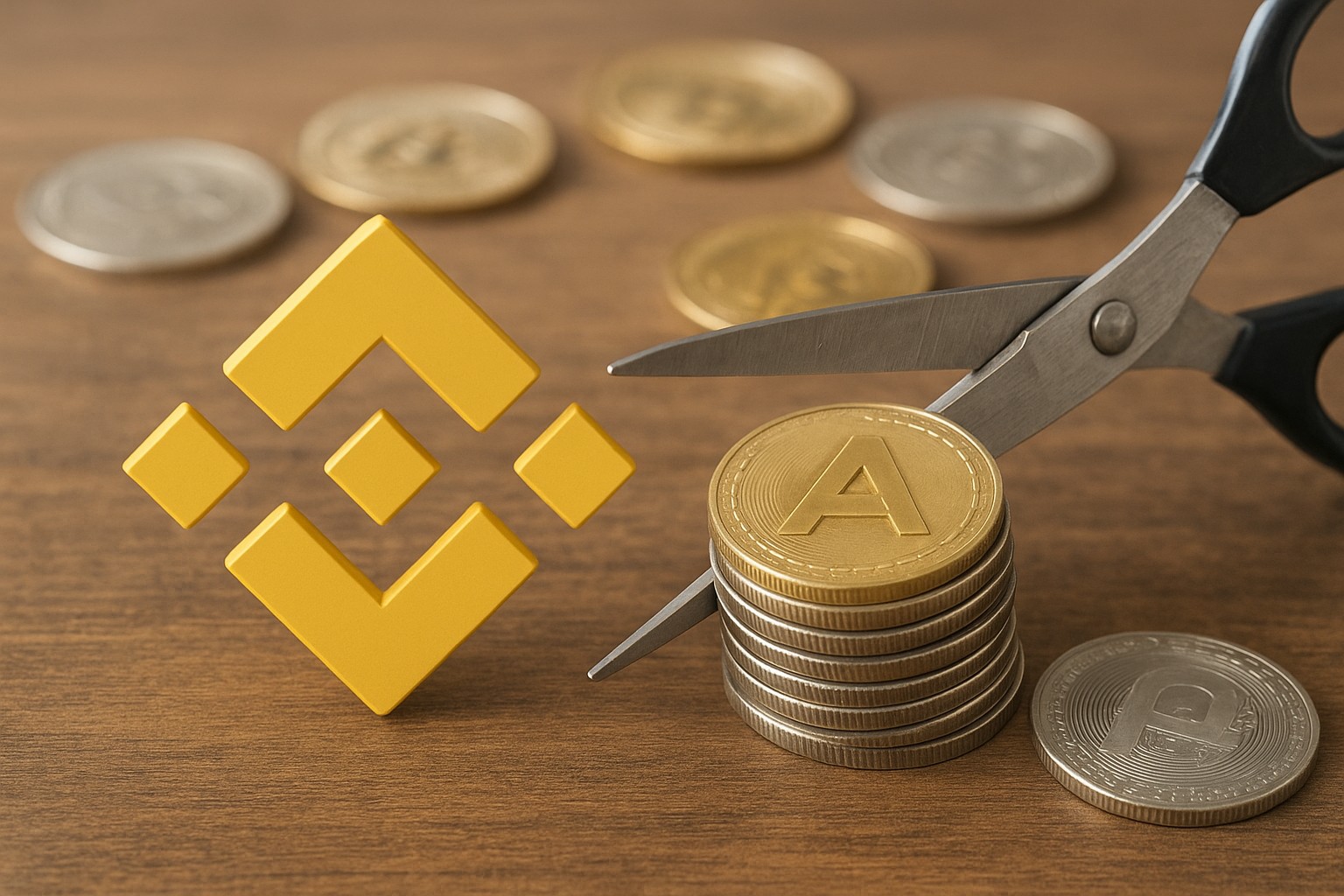
Binance updates its listings by cutting 20 Alpha tokens, and the impacted coins are already drawing attention across the market. For traders, this kind of housekeeping matters because visibility, liquidity, and risk perception can change overnight—especially for small-cap, early-stage assets.
What happened: Binance Alpha trims 20 tokens from its feature list
Binance Alpha is often treated as a discovery layer for early projects—tokens that may be tradable or trackable through Binance’s ecosystem but are still considered higher risk than mature, deeply liquid markets. When Binance “cuts” tokens from Alpha featuring, it’s less like flipping a kill switch and more like removing a spotlight. Still, spotlight removal can quickly reduce attention, volume, and short-term demand.
This latest update involves a batch removal of 20 Alpha tokens after an internal review. Binance typically frames these decisions around whether projects continue to meet platform standards—standards that can include everything from ongoing development to market health. From a user perspective, the key takeaway is practical: even without an immediate spot delisting, a token can lose a major distribution channel for discovery.
In my experience reading exchange announcements, the market tends to react not just to the removal itself, but to the uncertainty it introduces. When an exchange doesn’t provide a token-by-token explanation, traders are left to infer whether the issue is liquidity, inactivity, security risk, or simply failure to keep up with evolving listing criteria.
See the impacted coins: the 20 Alpha tokens removed
If you’re scanning your portfolio or watchlist, here are the Alpha tokens impacted by the update. These are the names circulating in the announcement and related coverage, and they’re the ones most likely to see reduced visibility and thinner liquidity conditions after the change.
The impacted Alpha tokens include: PRAI, COMMON, PINGPONG, TAKER, JANITOR, GATA, KLINK, CORL, SWTCH, ARIAIP, LONG, ZKWASM, GORILLA, ECHO, LITKEY, FIR, GM, DELABS, DONKEY, and WHY.
Even if you’re not actively trading these assets, it’s worth noting a common pattern: many Alpha-stage tokens rely heavily on narrative momentum and exchange-driven discovery. Once that funnel narrows, spreads can widen and slippage can increase—especially during volatility spikes. For small positions, that might not matter; for large positions in illiquid tokens, it can become a real execution problem.
One more practical point: removal from Alpha featuring is not necessarily the same as a full removal from Binance infrastructure. Always verify the current status inside your Binance app (markets, deposits, withdrawals, convert availability) because functionality can differ by asset and region.
Five spot tokens face Binance delisting next (and why it’s different)
Alongside the Alpha cleanup, a separate and more consequential action has been signaled: five tokens are slated for spot delisting—ATA, FARM, MLN, PHB, and SYS. This is the change that typically forces traders to act, because spot pair removal directly affects the ability to buy/sell in the standard market interface.
A spot delisting usually triggers a chain of secondary effects: market makers pull out, liquidity fragments across smaller venues, and price discovery gets less reliable. If you’re holding any of these assets, your decision isn’t only whether you still believe in the project—it’s also whether you can tolerate the operational friction of moving to other exchanges, DEXs, or wallets.
From Binance’s perspective, spot delistings are often framed as routine quality control—reviewing whether tokens continue to meet requirements around development activity, transparency, liquidity, and user protection. For users, the most important habit is to treat delisting timelines like deadlines for planning, not last-minute alerts.
Binance delisting strategy gains speed: what the exchange is optimizing for
Binance delisting strategy gains speed as exchanges respond to two pressures at once: (1) keeping markets clean and liquid, and (2) demonstrating stronger risk controls in an environment where regulators and users are demanding higher standards. Whether you agree with every decision or not, the direction of travel is clear—more frequent reviews, faster cleanup, and more explicit market-wide criteria.
In practice, delisting momentum often accelerates after exchanges introduce structured processes such as user voting, enhanced monitoring tags, or periodic project checkups. The real-world implication is that listings are no longer a “once you’re in, you’re safe” milestone. A token can be listed, traded, and then later removed if it fails to maintain traction or meet compliance expectations.
Personally, I see this as a mixed bag. It can reduce the number of zombie markets that trap users in illiquid pairs, but it can also punish legitimate small projects that temporarily dip in volume or public attention. For traders, the only sustainable approach is to treat exchange support as conditional and to keep exit routes ready.
Practical steps for holders: risk management after Alpha removals and delistings
The most useful response is operational: check what changed, what you can still do, and what you should do next. The moment a token loses featuring—or faces spot delisting—you should assume liquidity conditions may deteriorate and that customer support queues may grow as more users rush to act.
A simple checklist to protect yourself
- Review the token’s current status in Binance (spot pairs, convert, margin, futures exposure, deposits, withdrawals)
- Reduce position size if liquidity is fading (test with small sells to estimate slippage)
- Move long-term holdings to self-custody if you plan to hold through turbulence
- Identify alternative venues (reputable exchanges, verified DEX pools) before the crowd rush
- Save key dates and set reminders 24–72 hours ahead to avoid last-minute network congestion
- Re-check contract addresses and official links to avoid phishing and fake “migration” scams
Another best practice is to separate conviction from convenience. You might still believe in a project—but if the easiest liquidity off-ramp is disappearing, your risk profile changes. Also consider taxes and reporting: rapid moves between exchanges and wallets can create messy cost-basis trails if you don’t document them.
Finally, do a quick portfolio hygiene pass. Alpha tokens, by definition, can be volatile and thinly traded. If your portfolio has drifted into too many micro-caps, a listing update like this is a reminder to rebalance into assets where you can reliably enter and exit positions.
What this means for traders and projects going forward
For traders, the lesson is that exchange-driven visibility is a factor you can’t ignore. A token can be fundamentally unchanged yet experience a sharp drop in attention once it’s no longer surfaced in a major ecosystem feature like Alpha. That can create short-term downside risk, but it can also create opportunity for disciplined buyers—if and only if liquidity remains workable and the project’s fundamentals are verifiably intact.
For projects, removals and delistings send a clear signal: maintaining exchange standards is ongoing work. That includes consistent development, clear communication, security best practices, and community engagement that isn’t just marketing. Exchanges increasingly expect measurable progress, not just a launch narrative.
The broader market impact is also worth mentioning. As large venues tighten their standards, liquidity may concentrate in fewer assets, while long-tail tokens migrate to DEX-first discovery. That’s not inherently bad, but it pushes more responsibility onto users—especially around smart contract risk, spoof liquidity, and self-custody safety.
Conclusion: stay proactive when Binance updates its listings
Binance updates its listings by cutting 20 Alpha tokens, and knowing the impacted coins helps you act before liquidity and sentiment shift too far. Treat Alpha removals as a warning light—reassess risk, check trading conditions, and plan your exits or transfers calmly.
If you hold any of the affected Alpha tokens or the five assets facing spot delisting (ATA, FARM, MLN, PHB, SYS), the most important edge isn’t prediction—it’s preparation. Keep timelines, verify what functions remain available, and prioritize execution quality over impulse decisions.