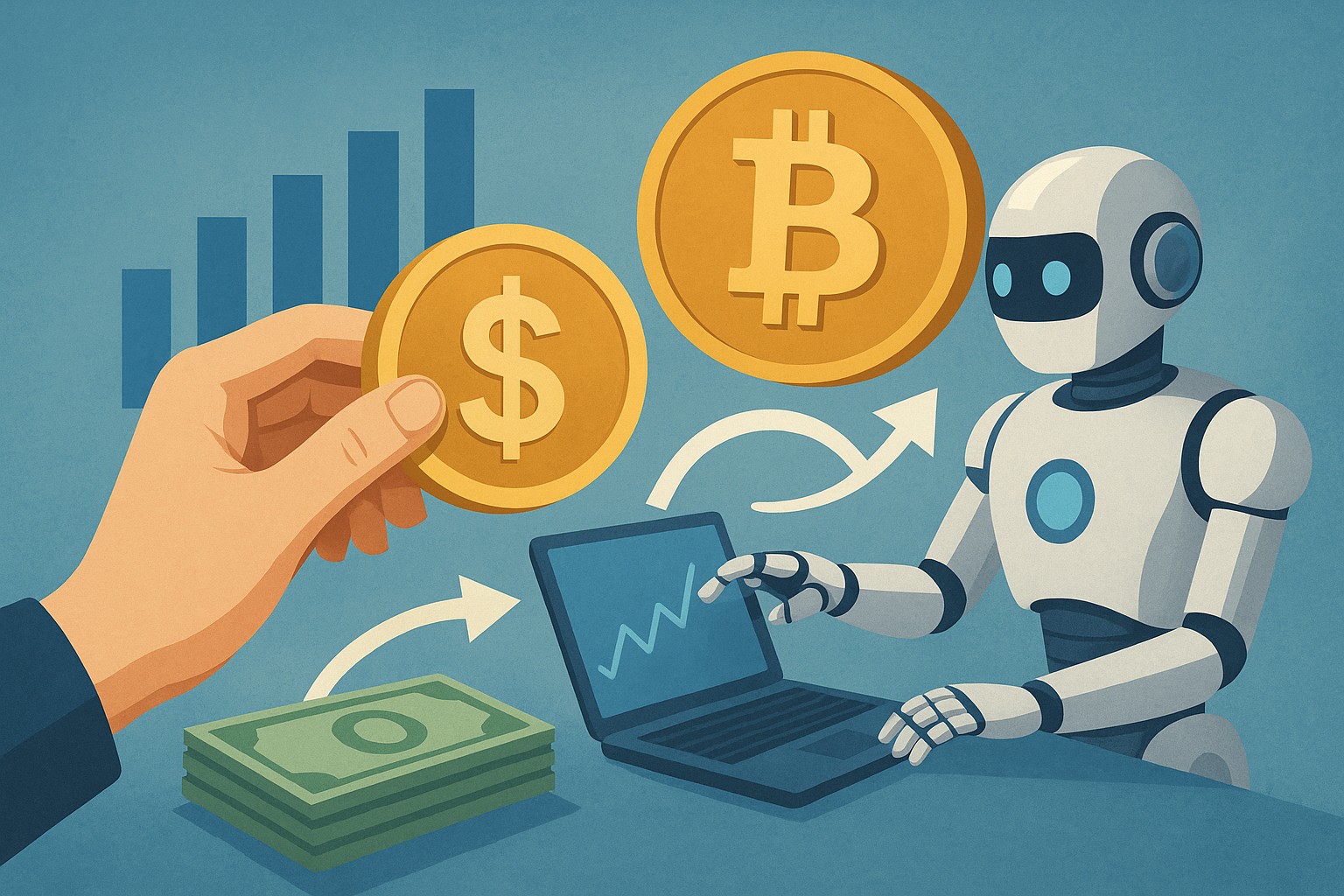
Crypto agent economy sees massive volume while bots recycle stablecoins at scale. Beneath the headline numbers is a quieter story about automation, payment rails, and what “real” on-chain usage should look like as AI agents become everyday market participants.
Introduction: why the agent economy suddenly matters
The phrase agent economy used to sound like a niche blend of AI and DeFi, but recent on-chain metrics have pushed it into mainstream crypto conversation. When you see eye-watering volume attributed to autonomous programs—trading, routing, arbitraging, and rebalancing—it’s tempting to equate that with adoption.
I’m more cautious. Big volume can be healthy, but it can also be circular. If bots recycle stablecoins at scale, the chain is busy without necessarily creating new economic value. Understanding the difference is crucial for investors, builders, and anyone trying to interpret market structure signals without being misled by raw throughput.
News: what “massive volume” in the crypto agent economy actually represents
The most important “news” angle isn’t just that automated activity is large—it’s that it’s increasingly dominant in certain ecosystems and time windows. Much of this machine-led flow is composed of repeatable, low-margin strategies that thrive on speed, cheap fees, and predictable liquidity conditions.
In practice, this means the same stablecoin units can change hands many times in a day. On a block explorer, it looks like huge economic activity. In reality, it might be a small set of actors (or even a small set of algorithms) cycling funds through pools, bridges, and order books to capture spreads, incentives, and latency advantages.
This matters because narratives form around these numbers: “payments are booming,” “users are flooding in,” or “DeFi is back.” Sometimes that’s true. Sometimes the signal is simply that automated execution got cheaper and faster, or that a new incentive program made recycling profitable.
Markets: bot-driven stablecoin recycling and what it does to liquidity
From a markets perspective, bots recycling stablecoins can be both stabilizing and distorting. On the stabilizing side, arbitrage keeps prices aligned across venues, improves quoted spreads, and can make AMMs more efficient. It’s one reason DeFi can feel surprisingly liquid during calm periods.
On the distorting side, recycling can inflate “volume” and “active addresses,” creating a perception of organic demand that isn’t there. Incentive-driven churn can also pull liquidity toward the highest short-term yield rather than the most useful long-term markets, leaving certain pairs shallow once rewards end.
The takeaway: if you’re using on-chain volume as a proxy for adoption, you must separate transactional utility (real payments, real settlement, real hedging) from mechanical throughput (bots looping stablecoins because it’s profitable to do so today).
The machine that’s actually running: how agents and bots create scale
The agent economy is not a single technology—it’s an emergent stack. At the base are fast chains, cheap blockspace, and stablecoins. On top are DEX aggregators, MEV-aware routers, bridging services, and automated market-making logic. Finally, the “agents” layer adds decision-making: when to route, when to hedge, when to borrow, and when to rebalance.
A useful mental model is to treat many agent workflows like automated treasury management. The agent is not “speculating” in the human sense; it’s following constraints—keep exposure within bounds, maintain inventory, seek best execution, and monetize incentives. If the strategy is robust, it can run 24/7 and keep compounding tiny edges.
Common stablecoin recycling loops (and why they exist)
- Incentive loops: bots cycle funds through pools or lending markets to farm rewards that exceed fees and slippage
- Cross-venue arbitrage: buy/sell stablecoins across DEXs and CEX gateways to capture small price deviations
- Bridge-and-back churn: move stablecoins across chains to exploit temporary rate differences or liquidity programs
- MEV-aware routing: reorder or bundle swaps to capture price impact and backrun opportunities
- Market-making rotations: maintain quotes by continuously swapping and rebalancing inventory around a target allocation
My personal commentary: none of these are inherently bad. The problem is interpretability. Without context, the same behavior can look like a payments boom, a liquidity renaissance, or a user growth explosion.
Hybrid by design: why “decentralized” agent flows still lean on centralized rails
Even when strategies are executed on-chain, the on/off ramps, custody choices, and payment gateways often remain centralized. That’s what makes the system “hybrid by design.” Stablecoins themselves can be issued by centralized entities, redeemed through compliance-heavy channels, and integrated into card networks or bank rails that are not crypto-native.
This hybrid reality shapes the agent economy in two ways. First, it concentrates risk: if key gateways tighten policies, face outages, or change redemption terms, on-chain automation can seize up. Second, it can create uneven playing fields: some participants have privileged access to fast settlement rails, better banking partners, or larger redemption capacity.
For builders, the hybrid nature is also an opportunity. Tools that abstract away compliance, payouts, invoicing, and reconciliation—while still settling on-chain—can turn today’s bot-heavy activity into tomorrow’s real commerce. But it requires acknowledging that pure on-chain loops are not the whole story.
The rail problem: what has to improve for “real” payments and adoption
The rail problem is simple to describe and hard to solve: moving value on-chain is easy; moving it into the real economy reliably, cheaply, and compliantly is harder. If the agent economy is to be more than bots recycling stablecoins, it needs rails that support everyday business workflows.
Better rails typically mean improvements in four areas. First is identity and compliance tooling that can be embedded without turning every app into a bank. Second is settlement guarantees and dispute handling for commercial payments. Third is predictable fees and uptime so automation can be trusted. Fourth is interoperability that doesn’t rely on fragile bridging assumptions.
A practical way to evaluate “rails readiness” is to ask: can a business pay 1,000 suppliers across multiple countries using stablecoins, with automated invoices, tax reporting hooks, and audit trails—without relying on a small set of manual operations? If the answer is no, then a lot of “payments volume” is still mostly internal crypto circulation.
Learn: how to spot genuine demand vs recycled stablecoin volume
If you’re analyzing chains, protocols, or token ecosystems, you can go beyond headline volume with a few disciplined checks. This isn’t about dismissing bots; it’s about measuring whether bot activity is supporting real usage or substituting for it.
Start by triangulating multiple metrics: unique counterparties, retention over time, fee sensitivity, and concentration. Then look for behavioral markers of commerce—like recurring payroll-like payments, merchant settlement patterns, or stablecoin flows that end in known off-ramp addresses rather than returning to the same DeFi loop.
I also like to examine “volume durability.” If volume collapses immediately after incentives end, that’s a sign the activity was mostly programmatic extraction. If volume remains and diversifies into different apps, it suggests real product-market fit.
Two paths from here: where the agent economy could go next
The agent economy faces a fork. One path is continued financialization: more automated market-making, tighter arbitrage, faster routing, and increasingly sophisticated strategies that keep stablecoins in motion. This path can be lucrative and can improve efficiency, but it risks becoming an ecosystem optimized primarily for other machines.
The other path is utility expansion: agents that do real work—paying invoices, managing subscription payments, settling gig-economy payouts, running treasury policies for DAOs and SMEs, and coordinating across chains for real-world services. In that world, volume still grows, but it’s tied to measurable outcomes beyond trading.
My view is we’ll get both. The key is whether infrastructure teams, stablecoin issuers, and app developers prioritize the boring parts—accounting, compliance, reliability, and user protection. That’s how you convert recycled liquidity into durable economic activity.
Conclusion: massive volume is a clue, not a verdict
Crypto agent economy sees massive volume while bots recycle stablecoins at scale, and that combination can either signal a thriving machine marketplace or a noisy mirage. The truth usually sits in between: automation provides real efficiency, but it can also inflate metrics and obscure whether adoption is broadening.
If you’re investing, building, or researching, treat bot-driven volume as the starting point. Ask what the flows do, where they end, and whether the rails support real commerce. When agent activity moves beyond loops and into repeatable real-world settlement, that’s when the agent economy becomes more than a headline—it becomes a foundation.