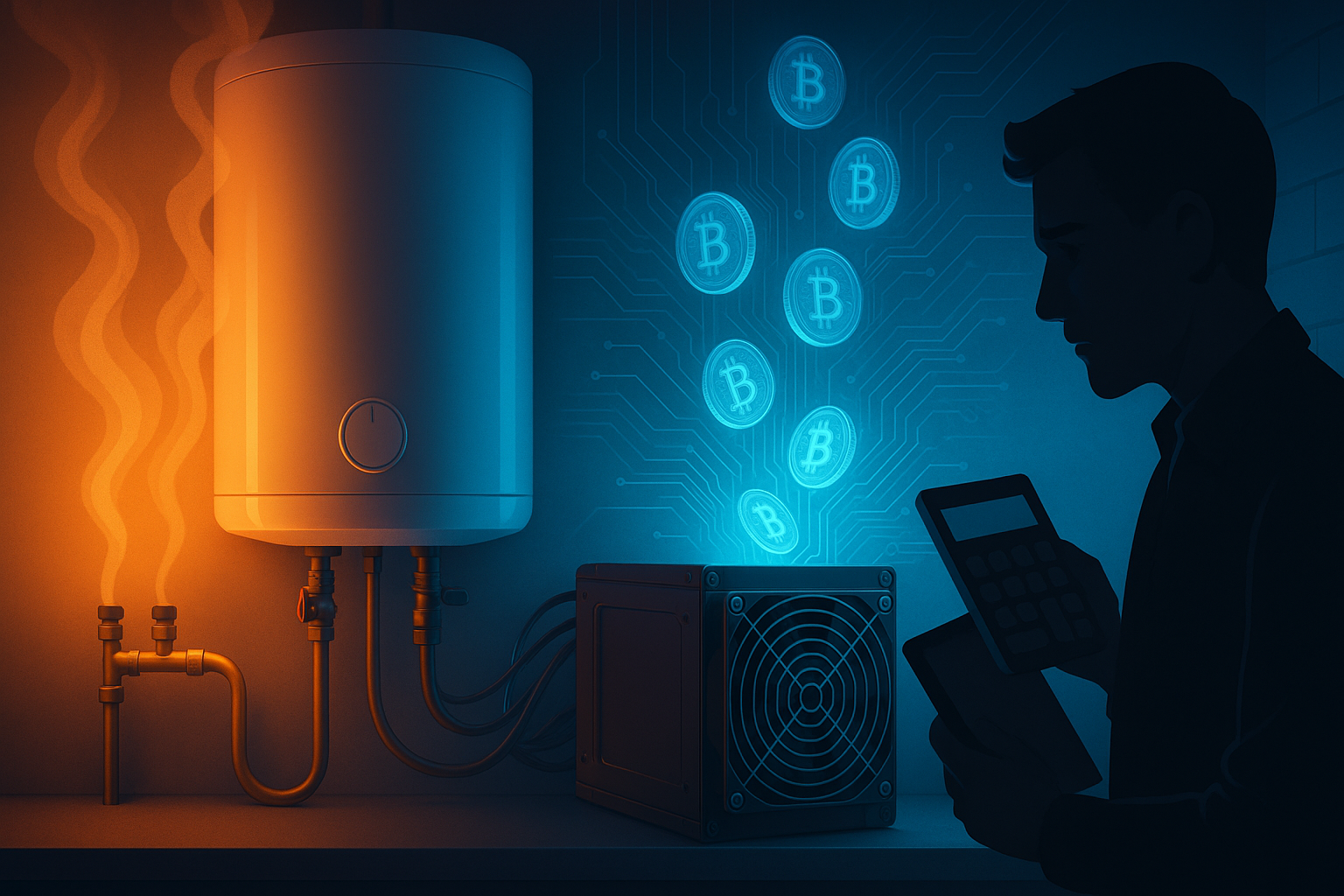
Bitcoin water heater cost is no longer a niche question in 2026, because more homeowners are looking at heat-reuse mining devices as a way to offset energy bills while stacking sats. But the real numbers depend on your local electricity rate, hot-water demand, home plumbing, and how consistently you can run the unit. This guide breaks down what you’ll pay up front, what it costs to operate, and where the savings can realistically come from. You’ll also see example scenarios, a comparison table, and practical tips to avoid expensive surprises.
What a Bitcoin water heater actually is in 2026
How mining heat turns into usable hot water
A Bitcoin water heater combines a Bitcoin mining computer with a heat exchanger so the electricity used for mining becomes heat for your domestic hot water. In a typical setup, the miner’s waste heat is captured by a liquid loop and transferred into a storage tank (or directly into a hydronic circuit).
In practice, the bitcoin water heater cost is tied to two outputs: heat (measured in kWh or BTU) and Bitcoin (measured in sats). If you already need hot water daily, you’re reusing energy that would otherwise be wasted as hot air.
Common configurations you will see
In 2026, most products fall into these categories:
- Integrated tank units that look like a water heater but contain the mining and heat-transfer system.
- External mining module connected to an existing tank via a heat exchanger and pump.
- Hydronic-focused systems that prioritize space heating or pool heating, with domestic hot water as a secondary load.
Each configuration changes the bitcoin water heater cost through installation complexity, plumbing modifications, and controls.
Bitcoin water heater cost breakdown for purchase and installation
Hardware price ranges you should budget for
For 2026, a realistic bitcoin water heater cost for equipment alone often lands in the mid-to-high four figures, depending on hash rate, heat output, noise isolation, and safety certifications.
- Entry level: $2,500–$4,500 (lower hash rate, simpler controls)
- Mid range: $4,500–$8,500 (better efficiency, quieter, more robust heat exchange)
- Premium: $8,500–$15,000+ (higher hash rate, integrated tank, advanced monitoring, better warranties)
Remember that the sticker price is only part of the bitcoin water heater cost. Accessories and installation can move the total significantly.
Installation and permitting costs that add up
Installation varies widely. If you already have an electric tank and good access to power and plumbing, costs are lower. If you need panel upgrades, new circuits, or significant plumbing work, costs rise fast.
- Electrician labor and dedicated circuit: $300–$1,500
- Plumber labor and fittings: $400–$2,500
- Heat exchanger, pump, expansion tank, valves: $250–$1,500
- Permits and inspection (where required): $50–$500
A common all-in bitcoin water heater cost for a typical home ends up around $5,000–$12,000, with outliers on both ends.
Operating costs in 2026 and what changes them most
Electricity rate is the biggest lever
The ongoing bitcoin water heater cost is mostly electricity. A mining-based heater is essentially an electric heater plus a miner. If your power is $0.08/kWh, your economics look very different than at $0.22/kWh.
As a simple framing: if the unit draws 2 kW and runs 12 hours/day, that’s 24 kWh/day. At $0.15/kWh, that’s $3.60/day or about $108/month in electricity. That electricity becomes heat and mining work, but you still pay the utility.
Maintenance, downtime, and replacement parts
Compared with a standard electric tank, a Bitcoin water heater has more moving parts: pumps, fans (depending on design), control boards, and mining hardware that can fail or become obsolete.
- Coolant replacement or servicing (some designs): $50–$200/year
- Pump replacement every few years (varies): $150–$500
- Miner cleaning and dust control: time cost, sometimes filters
- Potential hashboard or PSU repair: $200–$1,000+
These items are often overlooked in bitcoin water heater cost estimates, but they matter for long-term ownership.
Where the savings come from and what is realistic
Heat offset compared with electric and gas water heating
The main “savings” argument is that you need hot water anyway. If the device provides a meaningful portion of your hot water demand, it can offset energy you would have spent on a conventional heater.
If you currently use an electric water heater, the heat offset is conceptually straightforward: kWh in becomes heat out. The bitcoin water heater cost then depends on whether the mining revenue and any efficiency gains outweigh added complexity.
If you use natural gas, the comparison is harder because gas may be cheaper per unit of heat. In that case, the bitcoin water heater cost may only make sense if your electricity is low-cost, your gas is expensive, or you value the Bitcoin exposure.
Mining revenue and why it should be treated as variable
Mining revenue changes with network difficulty, Bitcoin price, pool fees, uptime, and miner efficiency. In other words, you should not assume a fixed payback period. Treat mining proceeds as a variable credit against the bitcoin water heater cost, not a guaranteed return.
A safer way to model is:
- Calculate your hot-water heating value first (what you would pay without mining).
- Then add a conservative mining credit based on low-end expectations and realistic uptime.
- Stress test with higher difficulty and lower BTC price scenarios.
Side-by-side comparison of typical options
Specs and cost summary table
The table below summarizes common choices homeowners consider in 2026. Use it to sanity-check your expected bitcoin water heater cost against conventional alternatives.
| Option | Typical upfront cost | Typical operating cost driver | Potential savings or upside | Key downside |
|---|---|---|---|---|
| Bitcoin water heater | $5,000–$12,000 installed | Electricity rate and uptime | Heat reuse plus potential BTC mining credit | Complexity, variable mining returns |
| Standard electric tank | $800–$2,500 installed | Electricity rate | Low complexity, predictable performance | No revenue offset |
| Heat pump water heater | $1,800–$4,500 installed | Electricity rate, ambient temperature | High efficiency, lower bills | Needs space, performance varies by climate |
| Gas tank or tankless | $1,200–$5,500 installed | Gas price and venting needs | Often low cost per unit of heat | Combustion venting, emissions, gas line constraints |
How to estimate your payback without fooling yourself
A simple step-by-step model you can run at home
To estimate bitcoin water heater cost payback, keep the math simple and conservative:
- Estimate daily hot water energy: Look at your current water heating bill or use a smart meter estimate.
- Estimate usable run time: If you only need hot water in bursts, you may not be able to run the miner 24/7 without overheating the tank.
- Compute electricity cost: kW draw × hours × your $/kWh.
- Subtract avoided heating cost: What you would have paid for the same heat with your current heater.
- Add conservative mining credit: Use a low estimate and assume downtime.
- Include maintenance: Budget an annual amount and spread it monthly.
If the result is close to break-even, treat that as a warning: small changes in difficulty or power price can flip the outcome and increase your effective bitcoin water heater cost.
Key questions to ask before you buy
- What is my all-in installed bitcoin water heater cost, including electrical upgrades?
- What is my average electricity rate after fees and time-of-use pricing?
- Can I use the heat year-round, or will I be forced to throttle in summer?
- Does the product have safety certifications and a clear warranty?
- What happens if the miner becomes obsolete in 2–4 years?
Practical ways to lower bitcoin water heater cost
Choose the right home and usage profile
The best candidates are homes with consistent hot-water demand, decent mechanical space, and electricity rates that are not punitive. If your household uses a lot of hot water daily, you can keep the system running steadily, improving the effective bitcoin water heater cost per gallon delivered.
Seasonality matters too. If you can divert heat to a basement, radiant loop, or even a pool, you reduce forced downtime and improve overall economics.
Optimize for uptime and heat utilization
Uptime is everything. A unit that’s off because the tank is already hot produces no Bitcoin and no useful heat, yet you still paid the upfront bitcoin water heater cost.
- Use smart controls to target temperature bands rather than a single high setpoint.
- Insulate pipes and the tank to reduce standby losses.
- Schedule high-power operation during cheaper time-of-use windows if possible.
Conclusion
Decide with real numbers, then commit confidently
The true bitcoin water heater cost in 2026 is a combination of upfront equipment, installation, electricity, maintenance, and the very real uncertainty of mining revenue. For the right home, it can offset water-heating costs while providing a Bitcoin-denominated upside. For the wrong setup, it can be an expensive science project that never pencils out.
Gather your utility rates, estimate your hot-water demand, request an itemized installation quote, and run a conservative model. If the numbers work even under pessimistic assumptions, you’re in a strong position to move forward. Take the next step and price out a system that matches your home, then act decisively.








Comment